Hyperproof vs Vanta: Which GRC Platform Is Right for You?
Hyperproof vs Vanta is less about which platform has the longer feature list and more about the operating model your compliance program needs.
Hyperproof is usually the stronger fit for established governance, risk and compliance (GRC) teams that manage several frameworks, business units or risk programs and need flexible control mapping and cross-team workflows. Vanta is usually the more direct fit for teams that prioritize fast audit readiness, a broad catalog of prebuilt integrations and trust workflows such as security questionnaires and a customer-facing Trust Center.
Both products now cover compliance, risk, audits and evidence automation. The deciding question is whether your biggest problem is GRC complexity or speed and automation breadth.
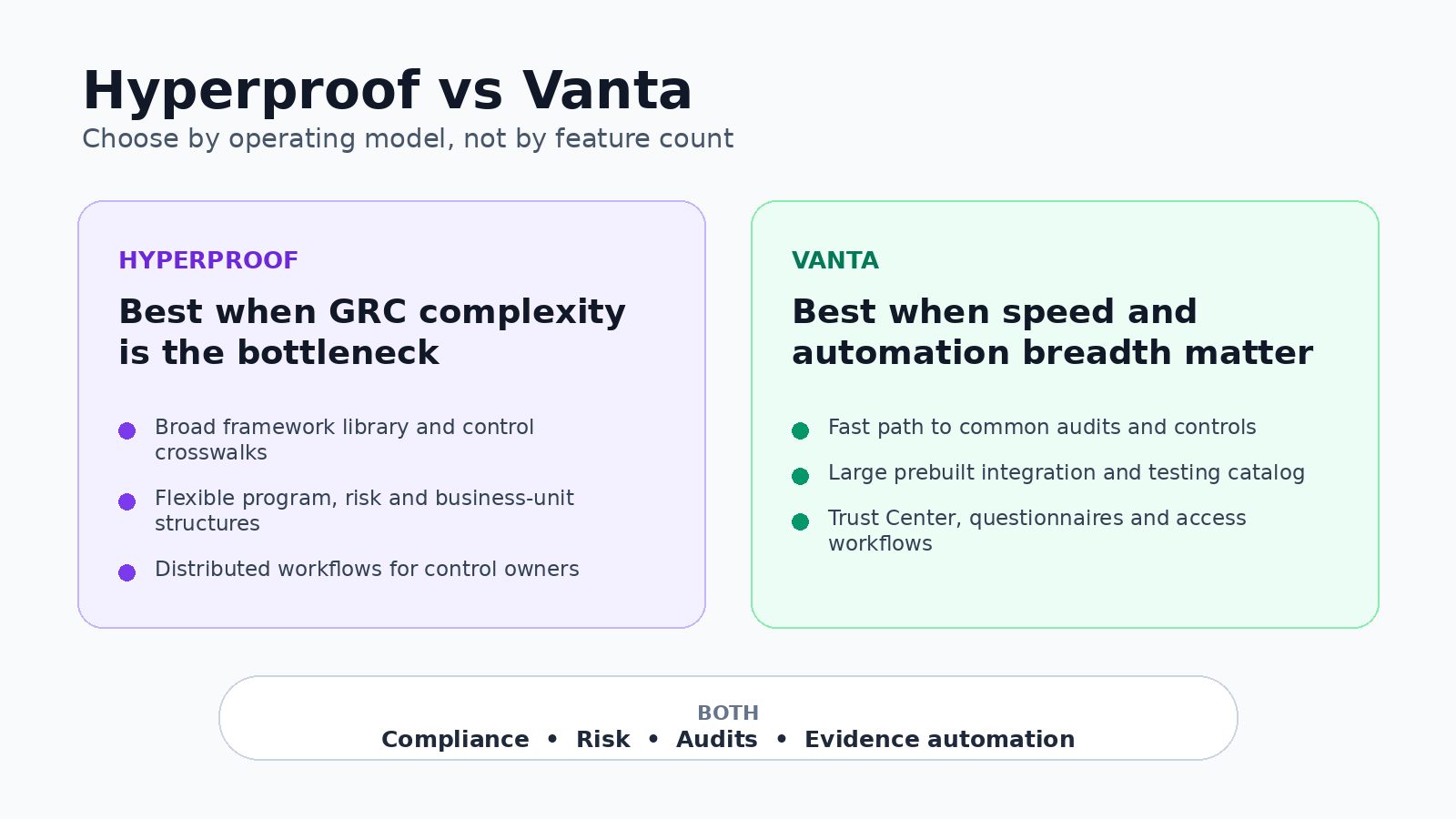
Hyperproof emphasizes flexible, multi-framework GRC operations. Vanta emphasizes automated trust management, rapid audit readiness and a broad integration ecosystem.
Hyperproof vs Vanta: the quick answer
- Choose Hyperproof if your organization runs multiple frameworks, needs to reuse controls and evidence across programs, or distributes compliance ownership across several business units.
- Choose Vanta if you want a faster path to an initial audit, extensive out-of-the-box integrations, and built-in workflows for trust centers, questionnaires and access management.
- Shortlist both if you are a mid-market or enterprise buyer. Vanta has expanded well beyond startup compliance, while Hyperproof can also support a first audit. Test each platform with your real controls, evidence sources and reporting requirements.
Hyperproof vs Vanta comparison table
| Comparison area | Hyperproof | Vanta |
|---|---|---|
| Core orientation | Flexible GRC operations across compliance, risk and audit programs | Automated trust management combining compliance, risk, evidence monitoring and customer assurance |
| Best fit | Growing or mature GRC teams with multiple frameworks, business units, geographies or custom workflows | Lean security teams through enterprise programs that value fast deployment, broad integrations and trust workflows |
| First audit | Supports first-time programs, but its deeper configuration is most valuable when the program will expand | Strong fit for teams pursuing an initial SOC 2, ISO 27001 or similar certification quickly |
| Framework coverage | Hyperproof markets 160+ framework templates, including SOC 2, ISO 27001, NIST, HIPAA, CMMC, FedRAMP and custom programs | Vanta markets 35+ frameworks, including SOC 2, ISO 27001, HIPAA, PCI DSS, GDPR, CMMC and others |
| Cross-framework reuse | Control crosswalks and the Jumpstart approach are designed to reuse controls and evidence across frameworks | Cross-maps controls across supported frameworks and offers advanced control management on higher plans |
| Evidence automation | 200+ Hypersyncs automate evidence collection; an SDK supports custom connectors | 400+ prebuilt integrations and more than 1,400 continuous tests are advertised across its platform |
| Monitoring model | Configurable automated control tests and evidence-collection cadences | Continuous control monitoring, with Vanta describing hourly automated tests for supported checks |
| Risk management | Multiple risk registers, configurable workflows, hierarchical controls and links between risks, controls and evidence | Integrated business and vendor risk management with owners, workflows, dashboards and reporting |
| Workflow ownership | Strong emphasis on assigning controls and tasks across engineering, IT, HR, legal and business units | Task ownership, issue management and collaboration are built in; the experience is more standardized and automation-led |
| Audit management | Centralizes requests, evidence, controls and auditor collaboration across recurring audits | Audit preparation and evidence collection are core strengths, supported by auditor workflows and partner access |
| Trust Center | Trust capabilities are part of Hyperproof’s wider GRC positioning; confirm exact packaging and third-party dependencies in the quote | A built-in Trust Center is published in Vanta’s plans, with advanced functionality on higher tiers |
| Security questionnaires | Verify the exact native workflow and service model during the demo | AI-powered questionnaire automation is included at stated usage levels in several plans |
| Third-party risk | Dedicated third-party risk management capabilities are available | Vendor risk management is integrated into the broader trust platform |
| Access management | Compliance workflows can connect to identity and HR systems through Hypersyncs | Access reviews and automated access management are named plan features |
| Customization | A major strength: custom frameworks, custom controls, hierarchical structures, dashboards, workflows and connector SDK | Custom frameworks, tests, dashboards, reports and adaptive scoping are available, with depth varying by plan |
| AI capabilities | Hyperproof AI is positioned across compliance, risk, audit and assurance workflows | Vanta AI includes policy, questionnaire, issue-management and evidence-assurance workflows, depending on plan |
| Implementation | Usually benefits from deliberate scoping of programs, control libraries, owners, reporting and integrations | Often quicker for a standard first-audit use case; complex enterprise rollouts still require design and governance work |
| Pricing visibility | No standard public rate card; pricing is quote-based | Publishes plan names and feature packaging, but not standard dollar prices; final pricing is quote-based |
| Primary tradeoff | Greater flexibility can require more design decisions and administrative maturity | Faster standardization can be less attractive when a team wants highly tailored GRC structures or very broad framework depth |
Feature counts are vendor-reported and can change. Integration totals are not directly comparable: vendors count connectors, tests and supported actions differently.
The main difference: GRC flexibility versus automated trust operations
Hyperproof is built around the idea that controls, evidence, risks, audits and tasks should operate as a connected system. Its strongest use cases appear when a compliance program is no longer owned by one person or tied to one certification. A central team can maintain a common control set, map it to several frameworks and assign work to operators throughout the company.
Vanta began with a strong focus on automated compliance and audit readiness, but it should not be dismissed as a first-audit-only product. Its current platform includes risk management, vendor risk, reporting, Trust Center functionality, questionnaire automation, access management and enterprise controls. Vanta’s advantage is the amount of standardized automation it brings together around the wider trust process.
The practical distinction is this:
- Hyperproof gives a mature GRC team more room to model how the organization already operates.
- Vanta gives a security team a more opinionated system for automating common compliance and trust workflows.
Neither approach is inherently better. An opinionated system can reduce implementation time. A flexible system can reduce the work required to support a complex operating model over several years.
Framework coverage and control mapping
Hyperproof offers broader published framework coverage
Hyperproof currently advertises more than 160 framework templates. Its published library includes common commercial standards as well as programs such as NIST SP 800-53, NIST CSF, CMMC, FedRAMP, DORA, NIS2 and HITRUST. Hyperproof also supports custom frameworks.
That breadth matters if a team expects to add several regulatory or customer-driven requirements. The platform’s control crosswalks are designed to map one control to requirements in multiple frameworks, allowing the same evidence to support more than one program.
The feature should be tested with your actual scope. A large framework library does not automatically mean every template matches your industry interpretation, auditor expectations or internal control language.
Vanta covers fewer published frameworks but the common standards are well represented
Vanta advertises more than 35 frameworks. That is a smaller number than Hyperproof publishes, but it includes many standards that drive software and technology buying decisions: SOC 2, ISO 27001, HIPAA, PCI DSS, GDPR, CMMC and related programs.
For a company that needs two or three mainstream frameworks, raw library size may not matter. What matters is whether the exact framework version is supported, how much content is preconfigured, how controls are mapped and how exceptions are handled.
Decision point: Hyperproof has the clearer advantage when broad framework coverage and custom control structures are central requirements. Vanta remains competitive when your roadmap is concentrated around widely adopted standards and automation depth matters more than the number of available templates.
Evidence collection, integrations and continuous monitoring
Both products automate evidence collection, but their published numbers describe different things.
Hyperproof advertises more than 200 Hypersyncs. These connectors collect evidence from systems such as AWS, Azure, GitHub, Jira, Slack and Okta. The Hypersync SDK also allows a team to build custom connectors when a source is not available out of the box.
Vanta advertises more than 400 prebuilt integrations and over 1,400 continuous tests. Its catalog spans cloud infrastructure, identity, HR, endpoint, developer and business systems. This breadth can materially reduce setup work for a cloud-native company with a common technology stack.
Do not choose based on the headline count. During each demo, select ten evidence sources that matter to your audit and verify:
- Whether a production-ready connector exists.
- Which evidence objects it collects.
- How frequently each check runs.
- Whether the platform tests the evidence or only stores it.
- How failures are assigned, remediated and retested.
- Whether custom connector work is included in the implementation or billed separately.
Vanta has the stronger published case for integration breadth and preconfigured continuous testing. Hyperproof is compelling when evidence must connect to a highly customized control, risk and program structure.
Risk management, workflows and accountability
Hyperproof’s design is well suited to organizations where responsibility for compliance is distributed. Controls can be grouped by program, product line, geography or business unit. Tasks and evidence requests can be assigned to operators outside the GRC team, while central owners retain visibility across programs.
Its risk model is also positioned as part of the same operating system: risks connect to controls, evidence, compliance status and reporting. Multiple risk registers are useful when separate business units or risk domains require their own governance while leadership still needs consolidated visibility.
Vanta also provides integrated risk management, including risk owners, workflows, dashboards and reporting. Its current GRC product is not limited to monitoring audit checks. It combines business risk, vendor risk, compliance status and reporting within the same platform.
The difference is likely to appear in configuration depth rather than in a simple yes-or-no feature checklist. Ask each vendor to build one real workflow during the evaluation:
- A control fails in a cloud system.
- The issue is routed to an engineering owner.
- The owner proposes remediation and uploads or generates new evidence.
- The control is retested.
- Residual risk and framework status update.
- A compliance leader receives an audit trail and a report.
The platform that can model this workflow with the least manual coordination is the better fit for your team.
Implementation and ongoing administrative work
Vanta is often easier to stand up for a standard first-audit project. Prebuilt framework content, common integrations and automated tests reduce the number of decisions a lean team needs to make. That advantage is significant when the immediate goal is to establish a baseline program and reach audit readiness without a large internal GRC function.
Hyperproof’s value becomes clearer when implementation includes a broader control architecture. A team can design reusable controls, ownership structures, program hierarchies and reporting around its actual operating model. This may require more work at the start, but it can prevent each new framework or business unit from becoming a separate compliance project.
Do not treat implementation as a one-time software setup. Price and plan for these activities:
- Cleaning and mapping the existing control library.
- Confirming framework scope and inherited controls.
- Connecting evidence sources and testing permissions.
- Defining owners, reviewers, escalation paths and service-level expectations.
- Migrating historical evidence and audit records.
- Training control operators outside the GRC team.
- Establishing a process for connector failures and platform administration.
The correct comparison is not “Which demo looks simpler?” It is “Which platform will require less manual coordination over the next three audit cycles?”
Trust workflows, questionnaires and vendor risk
Vanta has a visible advantage when customer assurance is part of the buying decision. Its published plans include Trust Center functionality, questionnaire automation, access management and reporting. These features connect compliance work to the revenue process: the same policies, controls and evidence used for audits can help answer customer security reviews and publish approved assurance material.
Hyperproof covers governance, risk, compliance, audit, trust and third-party risk, but buyers should confirm how customer-facing trust pages and questionnaire workflows are packaged. Ask whether each capability is native, partner-delivered or licensed separately, and whether human review is included.
For vendor risk management, both products should be evaluated on more than questionnaire intake. Test onboarding, inherent-risk scoring, evidence collection, reassessment schedules, findings, remediation, exceptions and portfolio reporting.
Decision point: Vanta is likely to be the stronger shortlist candidate when Trust Center and questionnaire workflows are major requirements. Hyperproof deserves closer attention when third-party risk must share a deeply customized risk and control model with the rest of the GRC program.
Hyperproof vs Vanta pricing and total cost
Neither vendor publishes a standard dollar rate card that supports a reliable like-for-like price comparison. Vanta publishes tier names and feature packaging, while Hyperproof directs buyers to a custom proposal or demo.
The quote should separate these cost drivers:
- Platform subscription and required modules.
- Number of frameworks or programs.
- Employee, user or business-unit limits.
- Trust Center and questionnaire volumes.
- Vendor risk and access-review modules.
- Implementation and data migration.
- Premium support or professional services.
- Custom integrations and connector maintenance.
- Contract term, renewal caps and overage charges.
A lower subscription can become more expensive if the team must maintain spreadsheets, buy a separate questionnaire tool or hire consultants for ongoing administration. A more configurable platform can also cost more if it requires dedicated administrators. Compare three-year total cost using the same scope and internal labor assumptions.
Which platform should you choose?
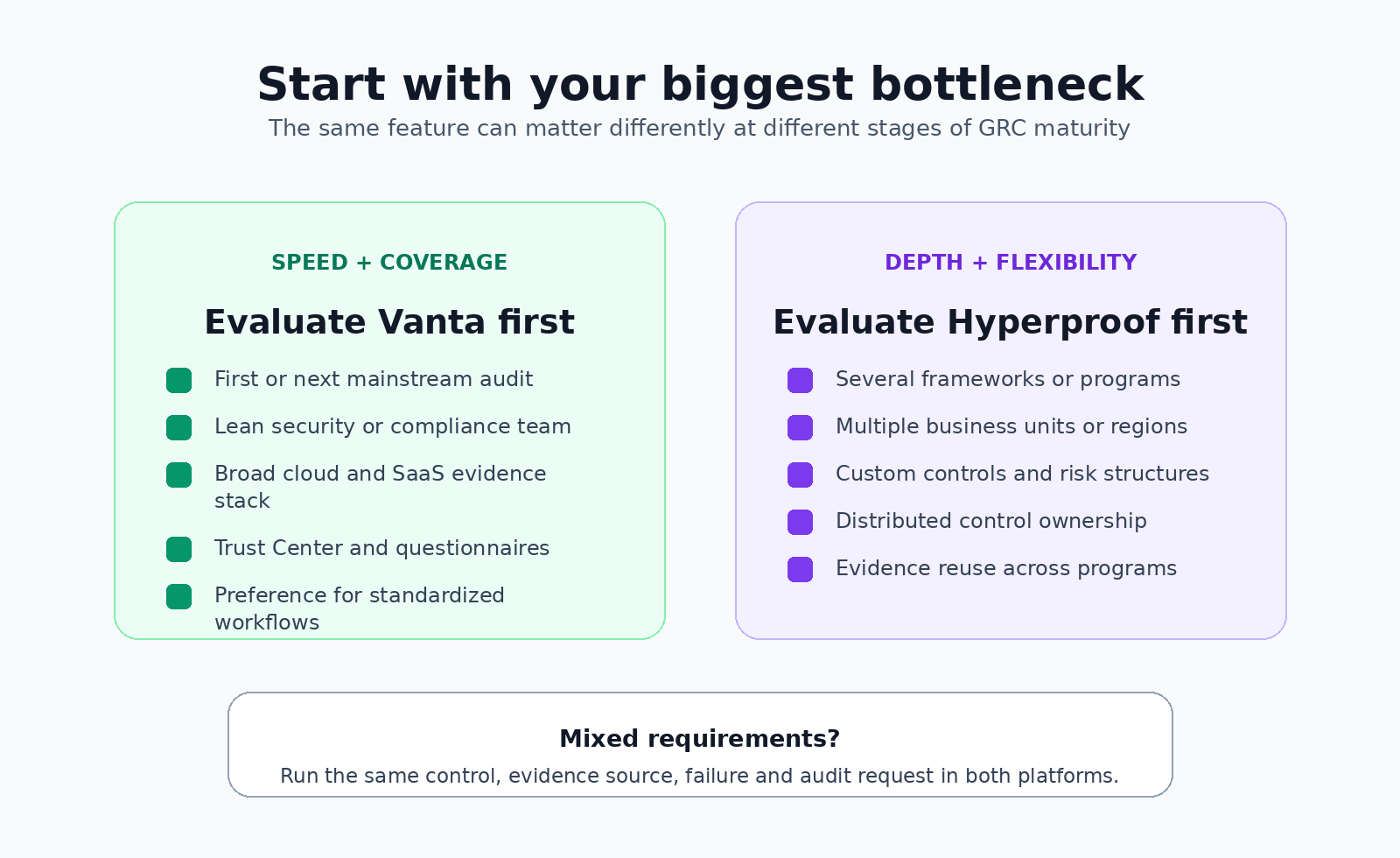
Choose Hyperproof when
- You manage several frameworks now or expect to add them quickly.
- Controls and evidence need to be reused across business units or programs.
- You require custom frameworks, hierarchical controls or multiple risk registers.
- Compliance ownership is distributed across engineering, IT, HR, legal and operations.
- Your GRC team wants to design workflows around an established operating model.
Choose Vanta when
- You need a direct route to an initial SOC 2, ISO 27001 or similar audit.
- Your stack is covered by Vanta’s prebuilt integrations and automated tests.
- A built-in Trust Center and questionnaire automation are high priorities.
- You want compliance, vendor risk, access management and customer assurance in one standardized platform.
- A lean security team prefers opinionated workflows over extensive configuration.
Shortlist both when
- You are a mid-market or enterprise organization with mainstream frameworks and a common cloud stack.
- You need both ongoing GRC operations and customer trust workflows.
- Your requirements depend on plan-specific capabilities rather than broad product positioning.
Run the same proof of concept in both platforms. Do not accept two different vendor-led demos as a valid comparison.
A practical demo scorecard
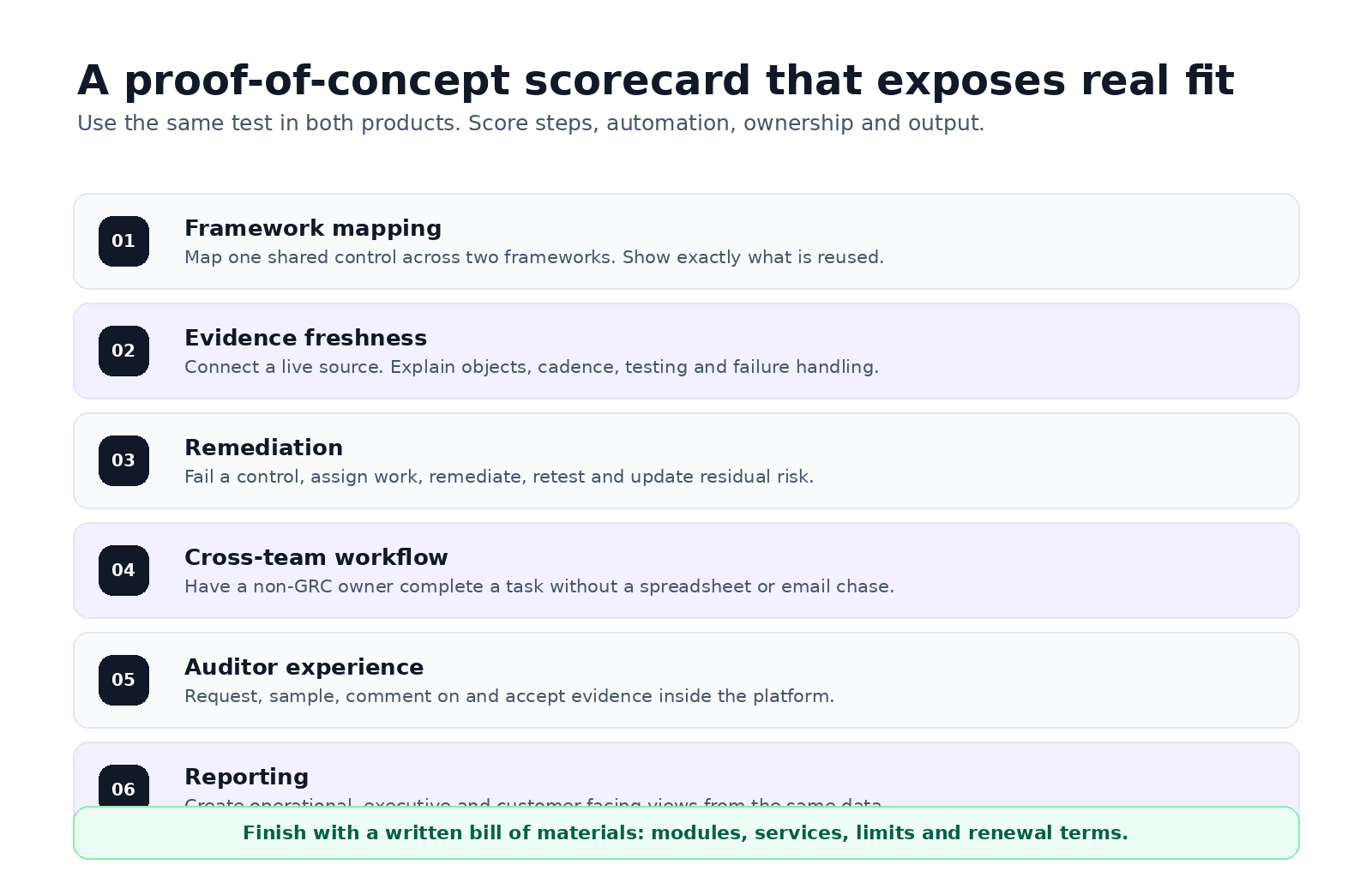
Score each platform against the same six tests:
- Framework test: Map one shared control across two frameworks and show what work is reused.
- Evidence test: Connect a real system, collect evidence and explain freshness and failure handling.
- Remediation test: Fail a control, assign it, remediate it, retest it and update risk.
- Workflow test: Involve a non-GRC control owner and measure the steps required to complete the task.
- Audit test: Let an auditor request, sample, comment on and accept evidence.
- Reporting test: Produce operational, executive and customer-facing views from the same data.
Also request a written bill of materials showing every module, service, usage limit and renewal assumption. This prevents a strong demo from turning into an incomplete production package.
Frequently asked questions
Is Hyperproof better than Vanta?
Hyperproof is a better fit when a mature GRC team needs broad framework coverage, flexible control mapping, custom workflows and distributed ownership. Vanta is a better fit when a team values rapid audit readiness, a larger published integration catalog and built-in trust workflows. The better product depends on your frameworks, evidence sources and operating model.
Is Vanta only for startups and first-time SOC 2 audits?
No. Vanta still has a strong first-audit use case, but its current platform also includes enterprise GRC, risk management, vendor risk, advanced reporting, access management, Trust Center and questionnaire capabilities. Enterprise buyers should evaluate its configurability by plan rather than relying on its earlier market positioning.
Which platform supports more compliance frameworks?
Hyperproof publishes the larger framework count, with more than 160 templates compared with Vanta’s published count of more than 35 frameworks. Library size should not replace a scope review. Confirm the exact framework, version, regional requirements and available crosswalks before buying.
Which platform has more integrations?
Vanta publishes more than 400 prebuilt integrations, while Hyperproof publishes more than 200 Hypersyncs and offers an SDK for custom connectors. These counts are not directly equivalent. Verify the connector, evidence objects, test cadence and remediation workflow for every critical system.
Which is better for SOC 2 compliance?
Vanta is often the more direct choice for a lean team pursuing its first SOC 2 because of its standardized setup and integration breadth. Hyperproof can be the better long-term choice when SOC 2 is one program within a larger multi-framework GRC environment.
Which is better for FedRAMP?
Hyperproof publishes FedRAMP as an out-of-the-box framework and offers a FedRAMP Moderate authorized environment through Hyperproof Gov. Buyers should still confirm the authorization boundary, framework content and service package required for their specific government use case.
Do Hyperproof or Vanta publish pricing?
Neither vendor publishes a standard public dollar rate card. Vanta publishes plan tiers and feature packaging, while Hyperproof uses a custom proposal process. Request like-for-like quotes with the same frameworks, modules, users, vendors, integrations and services.
Can both platforms automate evidence collection?
Yes. Hyperproof uses Hypersyncs and custom connectors to collect evidence. Vanta uses prebuilt integrations and continuous tests. The important difference is not whether automation exists, but whether it covers your systems, tests the right evidence and routes failures into an effective remediation process.
Can a company migrate from Vanta to Hyperproof?
Yes, but the migration should be treated as a control and evidence redesign rather than a file transfer. Inventory controls, framework mappings, owners, risks, policies, evidence history, audit records and integrations before moving. Run both systems in parallel through a limited validation period if the audit calendar allows it.
What should we test in a Hyperproof vs Vanta demo?
Use the same control, two frameworks, one live evidence source, one failed test and one audit request in both products. Compare the steps, permissions, automation, reporting and manual follow-up required. Then compare three-year cost using the exact modules shown in the demo.
Conclusion
The Hyperproof vs Vanta decision comes down to the shape of your compliance program.
Choose Hyperproof when the central problem is operating a complex GRC program across frameworks, teams and business structures. Choose Vanta when the central problem is reaching audit readiness quickly and automating a broad set of compliance and customer-trust workflows.
For buyers that sit between those profiles, feature lists will not settle the decision. A controlled proof of concept using the same frameworks, evidence and remediation workflow will.
Sources and verification notes
- Hyperproof’s official Hyperproof vs Vanta comparison
- Hyperproof product overview
- Hyperproof integrations and Hypersyncs
- Vanta GRC product overview
- Vanta plans and feature packaging
- Vanta’s official overview of Hyperproof alternatives
*Product capabilities, framework counts, integration counts and plan packaging change. Verify current requirements and contract scope directly with each vendor before making a purchase decision.
This article was informed by written insights from Debora Almeida, Content Marketing Manager at Hyperproof, with coordination and support from Sarah Huizingh, Senior Vice President of Marketing at Hyperproof. Codestory independently reviewed the information against current public documentation and maintained full editorial control over the comparison.*