Scytale vs Vanta: Which Compliance Platform Should You Choose?
Scytale vs Vanta is a choice between two credible ways to run security compliance. Both platforms automate evidence collection, track controls and help companies prepare for frameworks such as SOC 2 and ISO 27001. The most important difference is how much of the program your team wants to own.
Scytale is usually the stronger fit for teams that want compliance software paired with a dedicated GRC expert who guides implementation, remediation and audit readiness. Vanta is usually the stronger fit for teams that want a software-led platform with a large integration ecosystem, broad trust-management capabilities and more direct internal control over the program.
This is not simply “service versus software.” Both companies provide technology and support. The decision is about the default operating model: guided execution with hands-on expertise, or a platform your internal security and compliance team configures and runs.
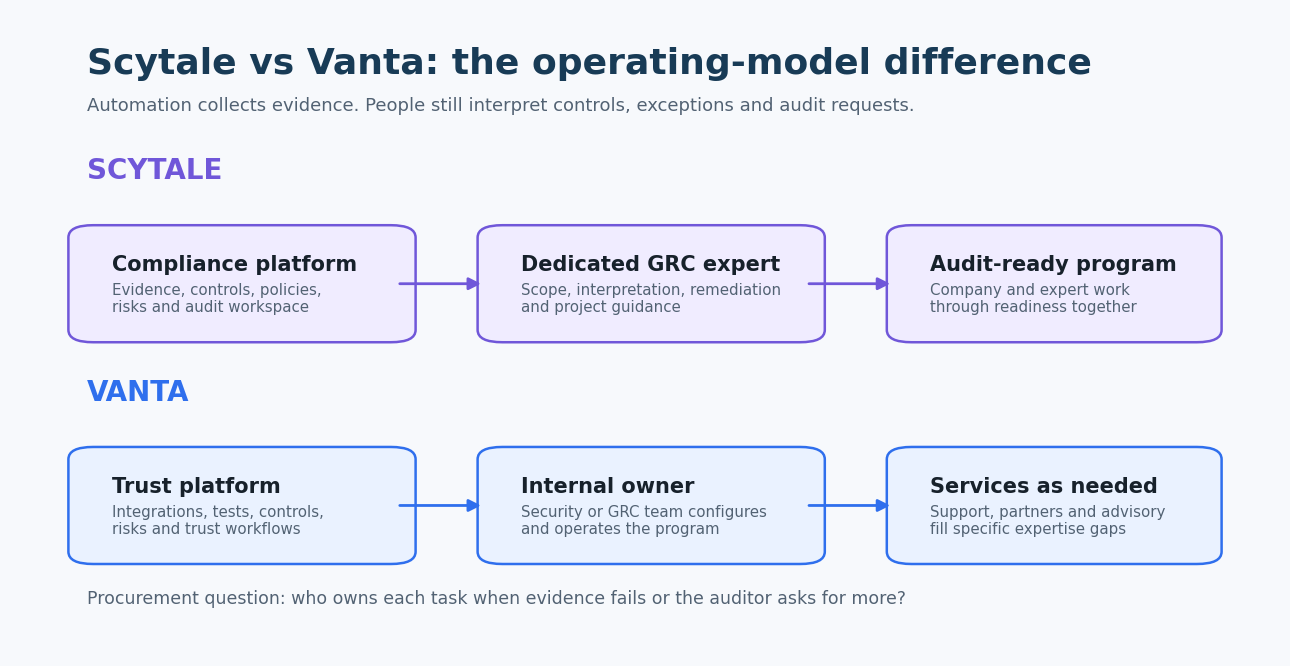
Scytale combines automation with a dedicated compliance expert. Vanta emphasizes a broad software platform that an internal team can operate directly, with services and partners available when needed.
Scytale vs Vanta: the quick answer
- Choose Scytale when a lean team needs an accountable expert to turn framework requirements into a working program, close gaps and coordinate the audit.
- Choose Vanta when an established security or GRC team wants extensive integrations, continuous monitoring, trust-center workflows and direct control at scale.
- Shortlist both for first-time SOC 2 or ISO 27001 projects. Compare the real implementation team, not only the demo: who writes policies, interprets evidence, manages exceptions and responds when a control fails?
Scytale vs Vanta comparison table
| Comparison area | Scytale | Vanta |
|---|---|---|
| Core product | Compliance automation platform delivered with hands-on guidance from in-house GRC experts | Trust management and compliance automation platform with integrations, monitoring and customer-facing trust workflows |
| Default operating model | Guided: software plus a dedicated compliance expert | Software-led: internal teams operate the platform, with support, services and partner options available |
| Best fit | Startups and growing companies with limited compliance headcount or a preference for managed guidance | Companies with internal security, compliance or IT ownership that want a broad platform and ecosystem |
| Framework coverage | Scytale advertises support for more than 80 frameworks and standards | Vanta advertises more than 35 frameworks and programs |
| First-time compliance | Strong fit when the team needs interpretation, task sequencing and audit preparation | Strong automation and templates; success depends on internal ownership or added advisory support |
| Evidence automation | Integrations collect evidence and map it to controls | Large integration catalog and automated tests collect and monitor evidence |
| Continuous monitoring | Tracks controls, tasks and gaps over time | Continuous tests, alerts and workflows monitor the security and compliance posture |
| Policy workflow | Templates and expert guidance support policy creation and review | Policy library, ownership, acceptance and review workflows are built into the platform |
| Risk management | Supports risk identification, treatment and framework workflows | Risk management capabilities connect risks, controls, tests and remediation |
| Vendor risk | Supports third-party risk and related compliance processes | Vendor risk management is available within Vanta’s broader trust platform |
| Personnel compliance | Automates people-related evidence and onboarding tasks | Integrates HR and identity systems for personnel controls and access workflows |
| Audit readiness | Dedicated experts help review evidence, remediate gaps and coordinate the audit process | Auditor access and evidence workflows streamline audit collaboration; internal teams remain key owners |
| Auditor relationship | Service model is designed to guide the company through auditor requests and readiness | Works with audit partners and supports in-platform auditor collaboration |
| Trust center | The Scytale Trust Center is an interactive portal providing real-time access to Scytale’s security posture, compliance certs, and data privacy controls. | Vanta Trust Center is a prominent product for publishing security posture and managing access to trust content |
| Security reviews | Guided support can help teams organize responses and evidence | Questionnaire automation and trust workflows support security-review response at scale |
| Integrations | Connectors automate evidence from common cloud, identity, code and business systems | Broad integration ecosystem is a central product strength |
| Multi-framework reuse | Controls and evidence can support several frameworks, guided by experts | Common-control mapping helps teams reuse tests and evidence across programs |
| Internal control | Lower operational burden when the team delegates guidance and project management | High direct control for organizations with established compliance processes and administrators |
| Pricing approach | Quote-based and shaped by frameworks, scope and service requirements | Quote-based packages and modules; scope, employee count and product selection can affect pricing |
| Main tradeoff | The value depends heavily on service quality, expert fit and the boundaries of included work | The platform can still require substantial internal program management and specialist judgment |
Framework catalogs, packages and service terms change. Confirm the exact scope, integrations and responsibilities in the proposal you receive.
The main difference: who runs the compliance program?
Compliance automation products can collect cloud configurations, employee records and security evidence. They cannot remove the need for judgment. Someone still has to decide whether a control is correctly designed, whether an exception is acceptable, how a policy reflects actual practice and what remediation is sufficient.
Scytale makes that human layer part of its core delivery model. Its positioning pairs the platform with a dedicated GRC expert who helps translate framework requirements, manage the project, review evidence and prepare for the audit. That is valuable when the buyer is a founder, CTO, operations lead or first security hire who cannot spend weeks learning audit mechanics.
Vanta makes the platform the center of the program. Integrations, tests, controls, policies, risks and trust workflows give an internal team a broad operating system for compliance. Vanta also offers customer support and routes to advisory expertise, but buyers should establish exactly which implementation and remediation tasks are included.
Ask every vendor to complete a responsibility matrix during procurement:
- Configure integrations and evidence mappings.
- Confirm system scope and control applicability.
- Draft and customize policies.
- Design missing controls.
- Review failed tests and false positives.
- Collect manual evidence.
- Manage exceptions and risk acceptance.
- Prepare the auditor and respond to requests.
- Maintain the program after certification.
Ambiguity in that matrix becomes unplanned work for your team.
Automation, integrations and evidence quality
Vanta’s integration ecosystem is a major reason companies shortlist it. Connections to cloud providers, identity systems, source control, endpoint tools, HR systems and business applications can produce recurring evidence and automated tests. This is especially useful for organizations with a standardized SaaS stack and an internal owner who will tune the program.
Scytale also automates evidence through integrations. Its differentiator is the review loop around that automation. A dedicated expert can help decide whether a failed signal represents a real control gap, a configuration issue or evidence that needs a different source.
Integration count is a weak selection metric on its own. Validate each system you actually use:
- What objects and fields does the connector read?
- How often does it refresh?
- Which controls and tests consume the data?
- Can evidence be scoped to the correct accounts and production systems?
- How are connector failures and permission changes reported?
- Can an auditor trace an evidence item to its source and collection time?
Automated evidence that is incomplete or mapped to the wrong scope can create more review work than a well-designed manual control.
Framework coverage and multi-framework programs
Scytale publicly advertises support for more than 80 frameworks and standards, while Vanta advertises more than 35. Those figures are not directly comparable without checking depth. A platform may provide a complete automated program for one framework and lighter templates or mappings for another.
Start with the programs on your actual roadmap. A typical sequence may include SOC 2, ISO 27001, HIPAA, GDPR obligations or sector-specific standards. For each one, ask for:
- Current framework version and control set.
- Automated versus manual evidence coverage.
- Policy templates and required customization.
- Common-control mapping across frameworks.
- Auditor or certification-body workflow.
- Regional or industry-specific implementation guidance.
- Effort to add a second framework after the first is live.
Multi-framework value comes from reuse. If one access-control test and one evidence item can satisfy several mapped requirements, ongoing compliance becomes materially easier. Ask the vendor to demonstrate that reuse using your two highest-priority frameworks.
Audit preparation and remediation
The weeks before an audit expose the difference between a checklist and an operating program. Evidence must be complete for the audit period, exceptions need disposition, controls need owners and every policy must match what the company actually does.
Scytale’s service model is designed to provide hands-on support through readiness and audit coordination. Buyers should confirm the expert’s workload, response time, time zone, framework experience and whether that same person stays with the account after certification.
Vanta’s platform supports auditor access and organized evidence review. For mature teams, this can reduce request-by-request file handling and keep audit work connected to controls. Buyers without internal GRC experience should determine whether standard onboarding is enough or whether advisory services or an external partner are needed.
In either product, inspect a sample failed control. Ask the vendor to show:
- The original evidence and test logic.
- The owner and remediation deadline.
- Exception and risk-acceptance workflow.
- Comments and supporting attachments.
- Auditor-visible history.
- Retest and closure evidence.
That workflow matters more than a green dashboard during a sales demo.
Trust centers and security questionnaires
Compliance certification is often the beginning of customer assurance work, not the end. Sales teams still need to share reports, answer questionnaires and prove current controls.
Vanta’s Trust Center is a prominent part of its product. Companies can publish security information, control access to sensitive documents and connect assurance content to the broader trust program. Vanta also offers workflows intended to accelerate security questionnaire responses.
Scytale supports customer assurance within its compliance offering, and its experts can help organize the evidence and narrative behind a trust program. Buyers with high questionnaire volume should compare product depth directly: answer-library governance, source citations, approval workflows, CRM integration, analytics and secure document access.
If sales enablement is a major buying driver, invite a sales engineer or revenue-operations owner into the evaluation. The security team should not select a trust center without the people who will use it during deals.
Pricing and total implementation cost
Both vendors generally price through tailored proposals. The quote may depend on employee count, frameworks, entities, integrations, platform modules and service scope. A lower subscription price can still produce a higher project cost if outside consulting or significant internal time is required.
Build a 12-month cost model that includes:
- Platform subscription and required modules.
- Implementation or onboarding fees.
- Dedicated advisory or managed-service scope.
- Auditor or certification-body fees.
- Penetration testing and supporting security tools.
- Internal hours from engineering, IT, HR, legal and executives.
- Security questionnaire and trust-center workload.
- The second framework on the roadmap.
Also define the renewal state. Ask what expert support continues after the audit, how many frameworks remain active, and what happens to historical evidence if you leave.
Which compliance platform should you choose?
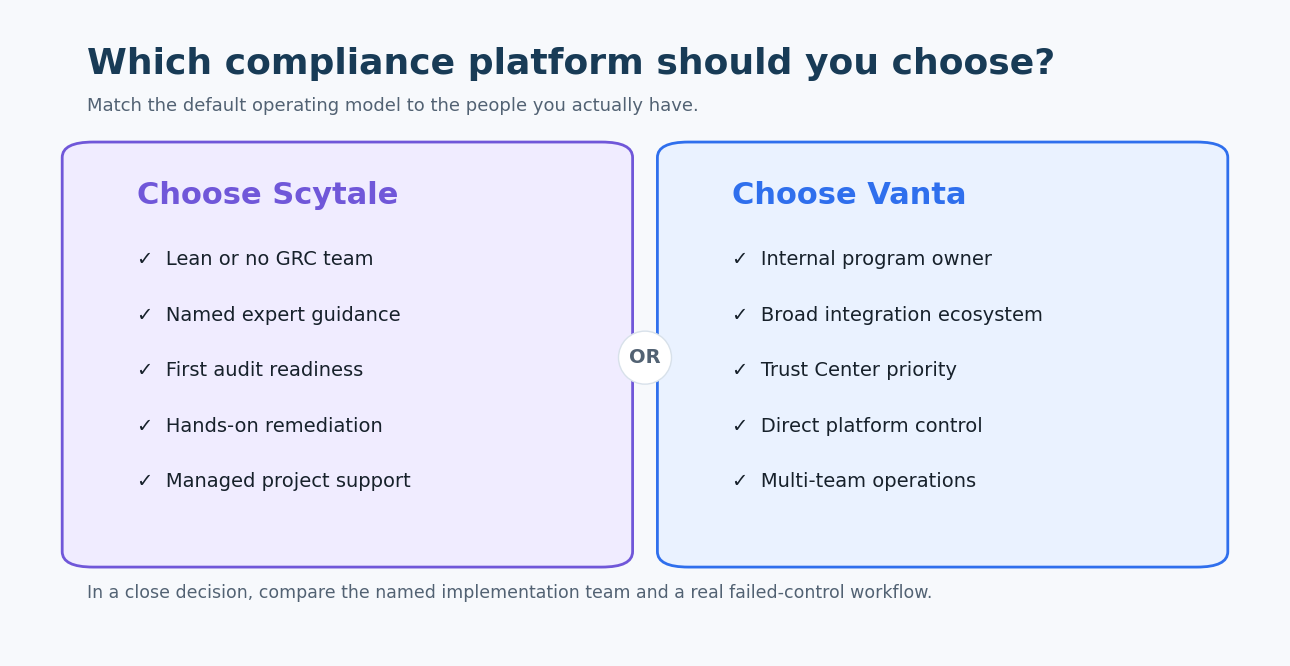
Choose Scytale when
- Your company has no dedicated GRC team or only a very small one.
- You want a named expert to translate requirements and drive the project.
- First-time audit readiness and remediation are the immediate priorities.
- Broad framework support matters and you need help sequencing programs.
- The team prefers a defined service relationship over assembling consultants separately.
- You can verify that the included expert scope covers the work you expect to delegate.
Choose Vanta when
- You have an internal security, compliance or IT owner for the program.
- Integration breadth and recurring automated tests are top requirements.
- A customer-facing Trust Center and questionnaire workflow are strategic.
- You want direct control over several compliance and trust-management modules.
- Your processes are mature enough to configure ownership, exceptions and remediation internally.
- Vanta’s partner and support model covers any specialist gaps.
Shortlist both when
- You are pursuing a first SOC 2 or ISO 27001 certification.
- Your technology stack is well covered by both integration catalogs.
- The decision depends on service quality and internal effort more than framework checkboxes.
- You expect to add frameworks and customer-assurance workflows over time.
Proof-of-concept and buying scorecard
Use the same scope, systems and sample controls in both evaluations.
| Test | What to evaluate | Decision signal |
|---|---|---|
| Implementation plan | Owners, sequence, timeline and excluded work | Reveals who will actually run the project |
| Evidence integration | Accuracy, scope, refresh and traceability | Tests automation quality rather than connector count |
| Failed control | Diagnosis, remediation, exception and retest | Shows day-to-day operating maturity |
| Framework reuse | One control mapped across two target programs | Validates multi-framework efficiency |
| Audit workflow | Auditor access, requests and evidence history | Predicts readiness effort |
| Trust workflow | Document access, questionnaire response and approvals | Tests support for revenue teams |
| Service quality | Named expert, credentials, capacity and response time | Measures the human layer behind the product |
| Total cost | Subscription, audit, services and internal hours | Produces a comparable 12-month number |
Frequently asked questions
Is Scytale better than Vanta?
Scytale may be better for a lean team that wants a dedicated expert to guide compliance and audit readiness. Vanta may be better for an established team that wants a broad software platform, extensive integrations and trust-management workflows. Neither is universally better.
Is Scytale a Vanta alternative?
Yes. Both automate evidence and support compliance programs. Scytale differentiates through a hands-on expert model, while Vanta emphasizes a software-led trust management platform and broad ecosystem.
Which is better for SOC 2?
Both support SOC 2. Choose based on ownership. Scytale is compelling when the team needs guided implementation and remediation. Vanta is compelling when an internal owner wants direct control of tests, controls, policies and auditor collaboration.
Which is better for ISO 27001?
Both support ISO 27001. Evaluate ISMS setup, risk treatment, policy customization, internal-audit preparation, management-review evidence and certification-body workflow. The amount of expert help included can materially change the workload.
Does Scytale include compliance experts?
Scytale positions dedicated in-house GRC expertise as a core part of its service. Confirm the named expert, availability, time zone, deliverables and ongoing support in the contract.
Does Vanta provide expert support?
Vanta provides support and access to services and partner options, but buyers should verify the exact advisory scope. Platform onboarding is not automatically the same as outsourced compliance program management.
Which platform supports more frameworks?
Scytale advertises more than 80 frameworks and standards; Vanta advertises more than 35. Verify the depth of support, current version, automation coverage and common-control mapping for the frameworks on your roadmap.
Which platform has better integrations?
Vanta’s broad integration ecosystem is a central strength. Scytale also connects common security and business systems. The meaningful test is whether each required connector collects the correct evidence from your production scope.
Which platform is cheaper?
Pricing is quote-based and depends on scope. Compare subscription, expert services, audit fees and internal labor over 12 months. A managed model may cost more in the quote but reduce internal time or outside consulting.
Can I switch from Vanta to Scytale or from Scytale to Vanta?
Yes, but plan for evidence export, policy history, control mappings, integration reauthorization, auditor access and trust-center content. Request a sample export and documented offboarding process before signing either contract.
Conclusion
The Scytale vs Vanta decision is fundamentally an ownership decision.
Choose Scytale when your team wants compliance automation plus a dedicated expert who helps drive implementation, remediation and audit readiness. Choose Vanta when your organization wants a broad, software-led trust platform that internal owners can configure and operate at scale.
Do not let a polished readiness percentage decide the purchase. Test one failed control, one manual evidence request, one audit exchange and one security questionnaire. Those workflows reveal the real cost of running the program after onboarding.
Contributor credit
This article was informed by written input from [email protected], SEO/GEO Manager at Scytale. We independently checked the comparison against current official documentation and treated company-specific positioning as vendor perspective. Connect with Dominique Sieweke on LinkedIn.
Official sources
- Scytale compliance platform
- Scytale ISO 27001 compliance
- Scytale multi-framework compliance guidance
- Scytale compliance automation overview
- Vanta trust management platform
- Vanta pricing
- Vanta Trust Center
- Vanta compliance frameworks
- Vanta comparisons and reviews
Product capabilities, framework catalogs and prices change. Verify the current documentation and contract terms before making a purchasing decision.