TuxCare vs HeroDevs: Which Open Source Lifecycle Platform Should You Choose?
TuxCare vs HeroDevs is a comparison between two vendors that help organizations keep using open source technology after normal community support becomes risky or unavailable. Their overlap is real, but their coverage and lifecycle strategies are not identical.
HeroDevs is usually the stronger fit when a team needs commercial drop-in support for a specific end-of-life framework, library or runtime covered by Never-Ending Support. TuxCare is usually the stronger fit when the organization needs broader coverage across Linux infrastructure and language ecosystems, or wants one strategy that combines trusted packages for actively maintained open source with extended support after end of life.
The decision should start with a dependency inventory. Neither vendor is “coverage for all open source.” Map the exact distribution, runtime, framework, version and transitive dependencies you cannot upgrade, then confirm what the contract will patch and for how long.
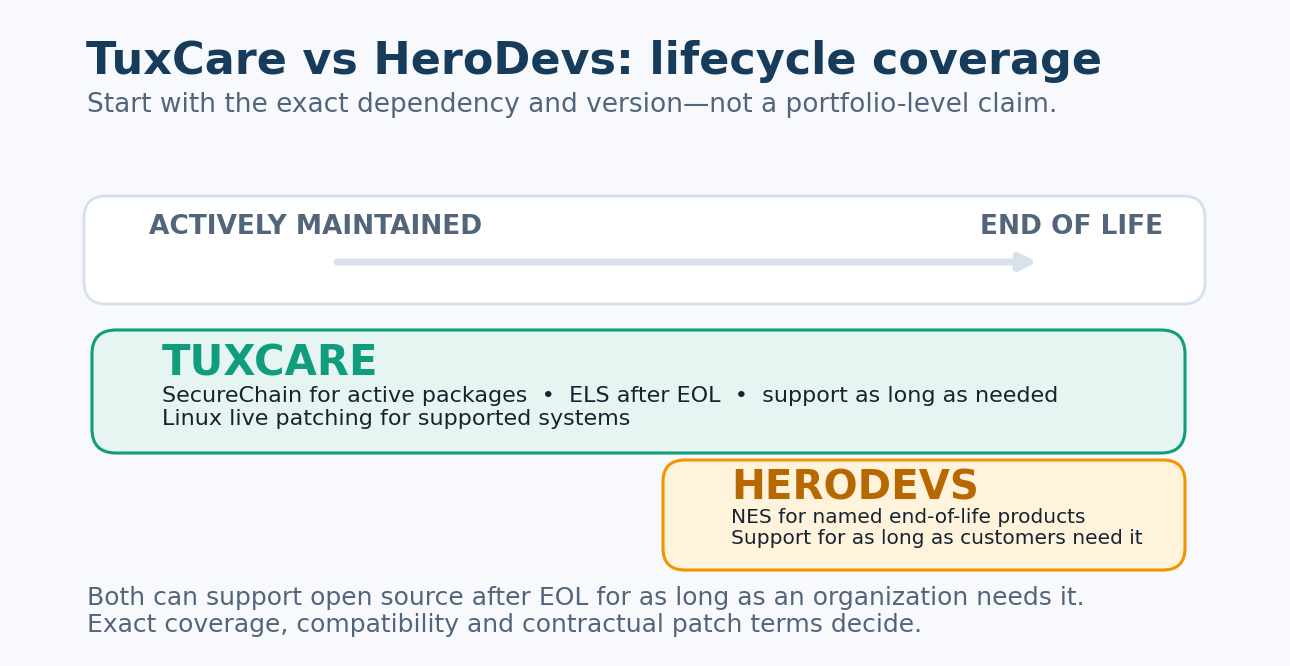
TuxCare spans active-package supply-chain security and extended lifecycle support. HeroDevs centers on keeping named end-of-life technologies secure and supportable while organizations plan modernization.
TuxCare vs HeroDevs: the quick answer
- Choose TuxCare for Linux distributions, infrastructure packages, broader language ecosystems, live patching requirements or a combined active-to-EOL open source security strategy.
- Choose HeroDevs for a covered end-of-life framework or runtime where a compatible replacement package, defined vulnerability response and modernization runway are the main requirements.
- Shortlist both when the estate includes several technologies. Ask each vendor for a written coverage matrix down to versions, package coordinates, transitive dependencies, CVE severity, patch SLA and delivery channel.
TuxCare vs HeroDevs comparison table
| Comparison Area | TuxCare | HeroDevs |
|---|---|---|
| Core product | Open source security portfolio spanning SecureChain for trusted active packages, Endless Lifecycle Support and Linux live patching | Never-Ending Support for commercial maintenance of end-of-life open source plus Evergreen lifecycle-governance capabilities |
| Best fit | Organizations with Linux, infrastructure and language-ecosystem risk across multiple lifecycle stages | Teams blocked on a covered EOL framework, library or runtime that need secure continued use and migration time |
| Lifecycle scope | Can address actively maintained packages through SecureChain and EOL technologies through extended support products | Primary differentiation is support for named technologies after official support ends; Evergreen adds estate visibility and lifecycle management |
| Technology coverage | Enterprise Linux distributions, applications, language ecosystems and infrastructure components vary by product | Published Never-Ending Support catalog spans dozens of product lines; eligibility is product and version specific |
| Delivery model | Vendor-maintained repositories, patched packages and live-patching services depending on product | Commercially maintained replacement packages and repositories designed for compatibility with covered EOL technology |
| Application change | Often uses familiar package-management or patching workflows; exact change depends on product | Designed to minimize code change for supported replacements, but package coordinates and testing still require work |
| Vulnerability remediation | Security patches are backported to supported versions under product-specific policies and service terms | Never-Ending Support advertises remediation for covered critical and high-severity CVEs under a published response commitment |
| Live patching | Core strength for supported Linux kernels and shared libraries, reducing reboot requirements | Not the central product model |
| Active open source packages | SecureChain provides curated packages with provenance and security metadata | Evergreen helps govern lifecycle risk; Never-Ending Support products focus on EOL technologies |
| Supply-chain provenance | SecureChain advertises SLSA Level 3 provenance, SBOMs and VEX information for supported packages | Product packages and security advisories provide supported-component information; validate required provenance artifacts |
| SBOM use | SecureChain metadata and product processes support dependency and vulnerability visibility | Evergreen and NES workflows can contribute to inventory and lifecycle risk management |
| Transitive dependencies | TuxCare positions SecureChain around supported dependency trees and curated package chains | Coverage depends on the named NES product and its included or compatible dependency set |
| Linux infrastructure | Broad strength across enterprise Linux maintenance and live patching | Coverage is more application-framework and runtime oriented, depending on the current catalog |
| JavaScript and application frameworks | Coverage exists for selected language ecosystems and EOL applications | Major strength, with products for specific frameworks and libraries in the published catalog |
| Modernization role | Buys time and reduces risk while teams plan upgrades; not a substitute for modernization | Explicitly creates a secure bridge for teams that cannot upgrade immediately; Evergreen supports planning and governance |
| Compliance support | Patch records, SBOM/VEX and supported software can help satisfy vulnerability-management evidence | Support status, vulnerability response and product artifacts can help demonstrate risk treatment for EOL dependencies |
| Pricing approach | Product- and estate-specific subscription or quote; scope varies by technology and system count | Pricing is organized by supported product, with enterprise terms and scope depending on usage |
| Procurement risk | Coverage must be validated across several product lines and dependency boundaries | A named technology may be covered while adjacent dependencies, plugins or forks are not |
| Main tradeoff | Broad portfolio requires careful product selection and ownership across infrastructure and application teams | Specialized EOL support can become expensive or fragmented when an estate needs many separate products |
Coverage catalogs, supported versions and remediation terms change. Obtain a contract-level coverage matrix before relying on either vendor for a critical dependency.
The main difference: breadth across the lifecycle versus product-specific EOL support
HeroDevs built its reputation around Never-Ending Support. The model is direct: when the community stops maintaining a technology, HeroDevs supplies a commercially supported replacement for covered versions. The goal is compatibility, security fixes and enough runway for the customer to modernize deliberately rather than through an emergency rewrite.
TuxCare has a broader portfolio. Endless Lifecycle Support covers selected products after end of life, while live patching addresses supported Linux kernels and shared libraries without normal reboot cycles. SecureChain moves earlier in the lifecycle by offering curated packages for actively maintained open source with build provenance and security metadata.
That difference matters when defining the program:
- A team with one unsupported application framework may prefer a narrowly scoped HeroDevs product.
- An enterprise with aging Linux systems, language runtimes and infrastructure components may prefer TuxCare’s broader coverage.
- An organization trying to improve the provenance of new packages as well as support old ones should evaluate SecureChain separately from ELS.
Do not treat a portfolio-level comparison as proof that your package is covered. The answer must be version specific.
Start with a dependency and lifecycle inventory
The most common buying mistake is beginning with a vendor demo before documenting the estate. Build an inventory that joins technical and business context:
- Package or product name and exact version.
- Package coordinate, repository and installation method.
- Direct and transitive dependency role.
- Community end-of-life date and current support status.
- Internet exposure and data sensitivity.
- Known CVEs and compensating controls.
- Application owner and upgrade blocker.
- Required support horizon.
- Target replacement and migration estimate.
Separate dependencies into four groups: still supported and easy to upgrade; still supported but operationally pinned; end of life with a migration underway; and end of life with no funded migration. Commercial extended support is usually most valuable in the last two groups.
Give vendors the inventory under a confidentiality agreement and require one of four written answers for every item: covered, conditionally covered, custom-scope candidate or unsupported.
Patch delivery and application compatibility
Both vendors aim to backport security fixes without forcing customers onto the latest major version. That does not eliminate testing. A backport changes code, and a replacement package changes the software supply path.
For HeroDevs Never-Ending Support, validate the package coordinate or repository change, supported build tools, private-registry options and compatibility with the plugins around the framework. A “drop-in” claim should be proven against your build and automated test suite.
For TuxCare, the installation path depends on the product. Linux ELS, language-ecosystem support, application ELS and live patching use different mechanisms. Confirm which repositories or agents are required, how package priority is controlled and whether the service fits immutable images, containers or disconnected systems.
Run a controlled implementation:
- Snapshot the current production artifact and dependency lockfiles.
- Add the vendor repository or replacement in a test environment.
- Rebuild from a clean cache and record every changed dependency.
- Run unit, integration, browser and performance tests.
- Scan the resulting artifact with the tools used in production.
- Exercise rollback to the original package source.
- Promote the exact tested artifact through normal release controls.
The TuxCare interview response did not provide a universal implementation time, and there should not be one. A single package replacement may be quick; a regulated fleet or complex framework ecosystem can take much longer.
Vulnerability response and security guarantees
The central purchase is not access to old code. It is a dependable process for finding, triaging and fixing vulnerabilities in that code.
HeroDevs publishes a 14-day commitment for remediation of covered critical and high-severity CVEs. Buyers should confirm when that clock starts, which severity source controls, whether exploitability affects priority, how exceptions are communicated and whether every NES product uses the same terms.
TuxCare publishes product-specific lifecycle and security information. Its value can include backported patches, live patching and security advisories across supported Linux and application ecosystems. SecureChain adds provenance, SBOM and VEX metadata for its curated packages. Tuxcare also provides SLA-backed patching commitments (ELS for Libraries, Securechain, ELS for Runtimes, ELS for Applications, ELS for OS).
Compare the complete vulnerability process:
- Discovery sources and monitoring frequency.
- Severity and exploitability criteria.
- Supported CVE classes.
- Patch-development and testing process.
- Target and contractual remediation times.
- Customer notification and advisory format.
- False-positive and not-affected statements.
- Emergency escalation for active exploitation.
- Patch availability for disconnected environments.
A public target is useful, but the contract and past performance are what reduce operational risk.
Provenance, SBOM and dependency-chain risk
SecureChain is a notable difference in the TuxCare portfolio. It is positioned as a curated source for actively maintained open source packages, with SLSA Level 3 build provenance plus SBOM and VEX artifacts. This addresses a different problem from EOL support: whether a package and its dependency chain were built through a controlled, verifiable process.
HeroDevs’ core NES proposition is narrower: maintain a named product after the upstream project stops. Its Evergreen offering expands the view toward inventory, lifecycle governance and remediation planning. Buyers with formal software-supply-chain requirements should ask both vendors to provide sample provenance, SBOM, VEX and advisory artifacts for the exact product under evaluation.
Check whether those artifacts flow into your existing tools. A PDF certificate that cannot be tied to a deployed package is less useful than machine-readable metadata connected to an SBOM platform, vulnerability scanner and deployment record.
Modernization strategy: support is a bridge, not a destination
Extended support is rational when an immediate migration creates more business risk than continued use of the old technology. It becomes dangerous when it removes the pressure to modernize indefinitely.
Create an exit plan before signing:
- Why the upgrade is blocked today.
- Which blocker the support contract mitigates.
- Target architecture and supported version.
- Engineering owner and funded milestones.
- Dependencies that must move together.
- Date to re-evaluate commercial support.
- Maximum acceptable support horizon.
- Evidence required to decommission the old version.
HeroDevs explicitly positions NES as secure runway, and Evergreen can support broader lifecycle governance. TuxCare similarly gives teams time through ELS while its wider Linux and supply-chain products can reduce risk elsewhere. Neither vendor should own the business decision to keep or retire the dependency.
Pricing and total cost
HeroDevs presents pricing by supported product, which aligns naturally to teams with one or two named EOL blockers. Costs can rise as more frameworks, runtimes or versions require separate coverage. Confirm production, development, CI and subsidiary usage rights.
TuxCare pricing depends on the product and estate. Linux support may be tied to systems or instances, while application and language support can have different units. SecureChain and live patching solve different problems and should be priced as separate value cases.
Compare three numbers:
- Support cost: subscription, onboarding, premium SLA and required products.
- Operating cost: repository management, testing, security review, SBOM integration and incident response.
- Avoided or deferred cost: emergency rewrite risk, audit findings, downtime and engineering pulled away from committed work.
Also model the migration. Commercial support can be the lowest-risk one-year choice and the highest-cost five-year choice if modernization never starts.
Which vendor should you choose?
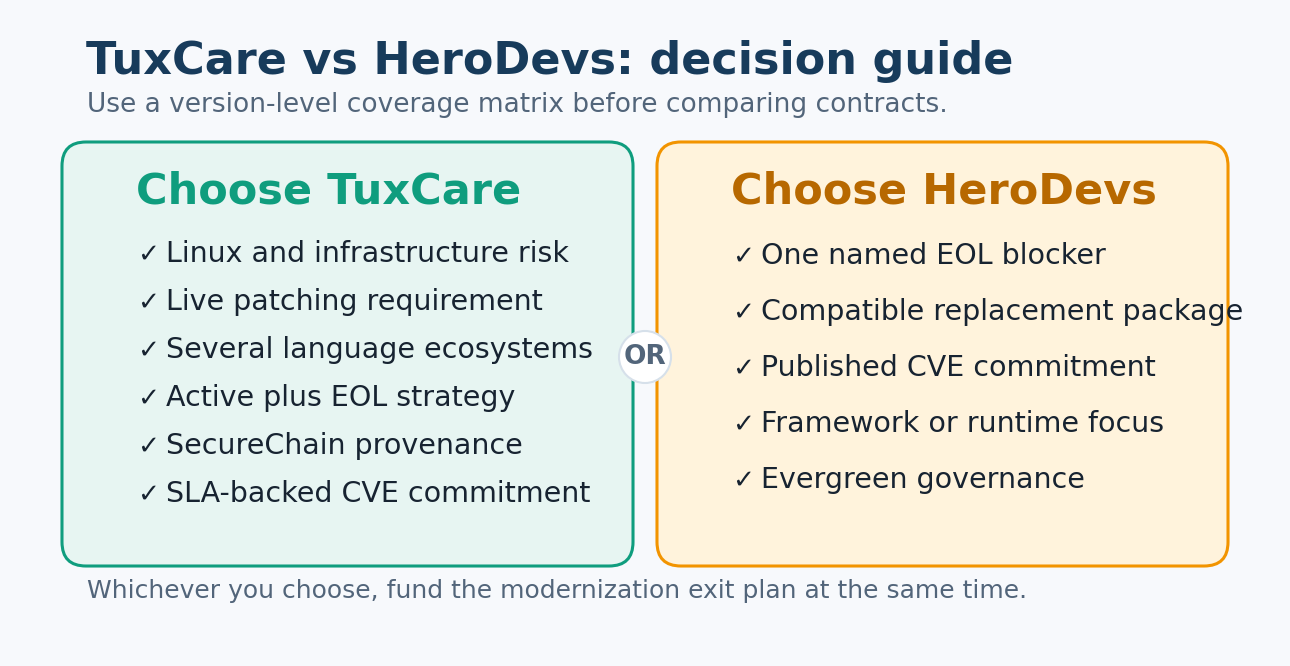
Choose TuxCare when
- The estate includes enterprise Linux, kernels, shared libraries or infrastructure packages as well as application dependencies.
- You need live patching for supported systems with reduced reboot pressure.
- Several language ecosystems or EOL applications require one broader vendor relationship.
- SecureChain’s curated active packages, provenance, SBOM and VEX fit the supply-chain strategy.
- You want coverage before and after community end of life.
- The exact products and versions are confirmed in writing.
Choose HeroDevs when
- A specific framework, library or runtime in the NES catalog is blocking modernization.
- A compatible replacement package is the cleanest short-term control.
- The published critical and high-severity CVE response commitment matches risk requirements.
- Product-specific pricing is easier to connect to the application owner.
- Evergreen’s inventory and lifecycle-governance model adds value beyond the immediate NES product.
- Adjacent plugins, build tools and transitive dependencies have been tested.
Shortlist both when
- The same language runtime or framework appears in both current catalogs.
- Your estate mixes infrastructure EOL risk with application-framework EOL risk.
- Procurement needs an independent comparison of patch SLAs and artifact quality.
- The final choice depends on version coverage and implementation compatibility rather than portfolio messaging.
Proof-of-concept and procurement scorecard
Run the test with one real affected application or system, not a sample project.
| Test | What to evaluate | Decision signal |
|---|---|---|
| Coverage matrix | Exact products, versions, plugins and transitive dependencies | Prevents false confidence from catalog-level coverage |
| Clean build | Repository change, lockfile delta and reproducibility | Measures implementation friction |
| Regression suite | Functional, performance and security results | Tests compatibility claims |
| CVE exercise | Advisory, patch, SLA clock and escalation path | Validates the service being purchased |
| Artifact evidence | SBOM, provenance, VEX and package signature | Supports supply-chain and audit requirements |
| Fleet operations | Staging, rollout, rollback and disconnected delivery | Predicts day-two effort |
| Support workflow | Named contacts, severity routing and response quality | Tests incident readiness |
| Three-year cost | Support, operations and funded migration | Prevents extended support from becoming the default forever |
Frequently asked questions
Is TuxCare better than HeroDevs?
TuxCare may be better for broad Linux, infrastructure and multi-ecosystem lifecycle needs. HeroDevs may be better for a specific covered EOL framework or runtime where a compatible commercial replacement is the priority. Coverage at the exact version level should decide.
Is TuxCare a HeroDevs alternative?
Yes, for some extended lifecycle support use cases. TuxCare also offers Linux live patching and SecureChain for active packages. HeroDevs specializes in Never-Ending Support for named EOL technologies and offers Evergreen for lifecycle governance.
What is end-of-life software support?
It is commercial maintenance after the original project or vendor stops providing normal fixes. The provider monitors vulnerabilities, backports patches and distributes supported packages for agreed versions. It reduces security risk but does not make an old architecture modern.
Which vendor covers more technologies?
The catalogs use different product groupings, so headline counts are not a reliable comparison. TuxCare spans Linux, applications and language ecosystems. HeroDevs publishes dozens of NES product lines. Compare exact versions, plugins and transitive dependencies.
Does HeroDevs require code changes?
Never-Ending Support products are designed to be compatible replacements, but teams may need to change package coordinates or repositories. Build configuration, plugins and runtime behavior must still be tested in the target application.
How is TuxCare ELS installed?
It depends on the product. A Linux distribution, language ecosystem, application package and live-patching service can use different repositories, agents or package-management steps. Follow the product-specific implementation guide and test rollback.
How fast do the vendors patch vulnerabilities?
HeroDevs advertises a 14-day commitment for covered critical and high-severity CVEs. TuxCare remediation terms vary by product and contract. Confirm severity rules, clock start, exceptions and actively exploited vulnerabilities in writing.
Can commercial support satisfy compliance requirements?
It can provide evidence that EOL risk is being treated through supported packages, patch records and response commitments. Auditors may still expect inventory, risk acceptance, timely deployment, testing and a modernization plan.
What is the difference between TuxCare SecureChain and ELS?
SecureChain focuses on curated, verifiable packages for actively maintained open source. Endless Lifecycle Support provides security maintenance for selected technology after normal support ends. They address different lifecycle stages.
Should we buy extended support or upgrade?
Buy support when an immediate upgrade is infeasible and the old version creates material security or compliance risk. Fund the upgrade at the same time. Compare the risk-adjusted cost of support plus migration with the cost and outage risk of an emergency rewrite.
Conclusion
The TuxCare vs HeroDevs decision starts with the technology you must keep running.
Choose HeroDevs when a specific product in the Never-Ending Support catalog needs a compatible, commercially maintained bridge. Choose TuxCare when the requirement spans Linux and application ecosystems, live patching or a broader active-to-EOL open source strategy.
Require version-level coverage, test the real application, review the vulnerability SLA and agree on an exit plan. Extended support is most valuable when it buys controlled modernization time—not when it becomes a reason to postpone modernization indefinitely.
Contributor credit
This article was informed by written responses from [email protected] of TuxCare, with coordination and additional help from [email protected] of TuxCare. We independently checked the comparison against current official documentation and treated company-specific positioning as vendor perspective. Connect with DeShea Witcher on LinkedIn and connect with Artem Karasev on LinkedIn.
Official sources
- TuxCare SecureChain for OSS
- TuxCare application Endless Lifecycle Support
- TuxCare language ecosystem support
- TuxCare open source security portfolio
- TuxCare SecureChain announcement
- HeroDevs Never-Ending Support
- HeroDevs Evergreen
- HeroDevs pricing
- HeroDevs open source support platform
Product coverage, supported versions and prices change. Verify the current documentation and contract terms before relying on extended support in production.