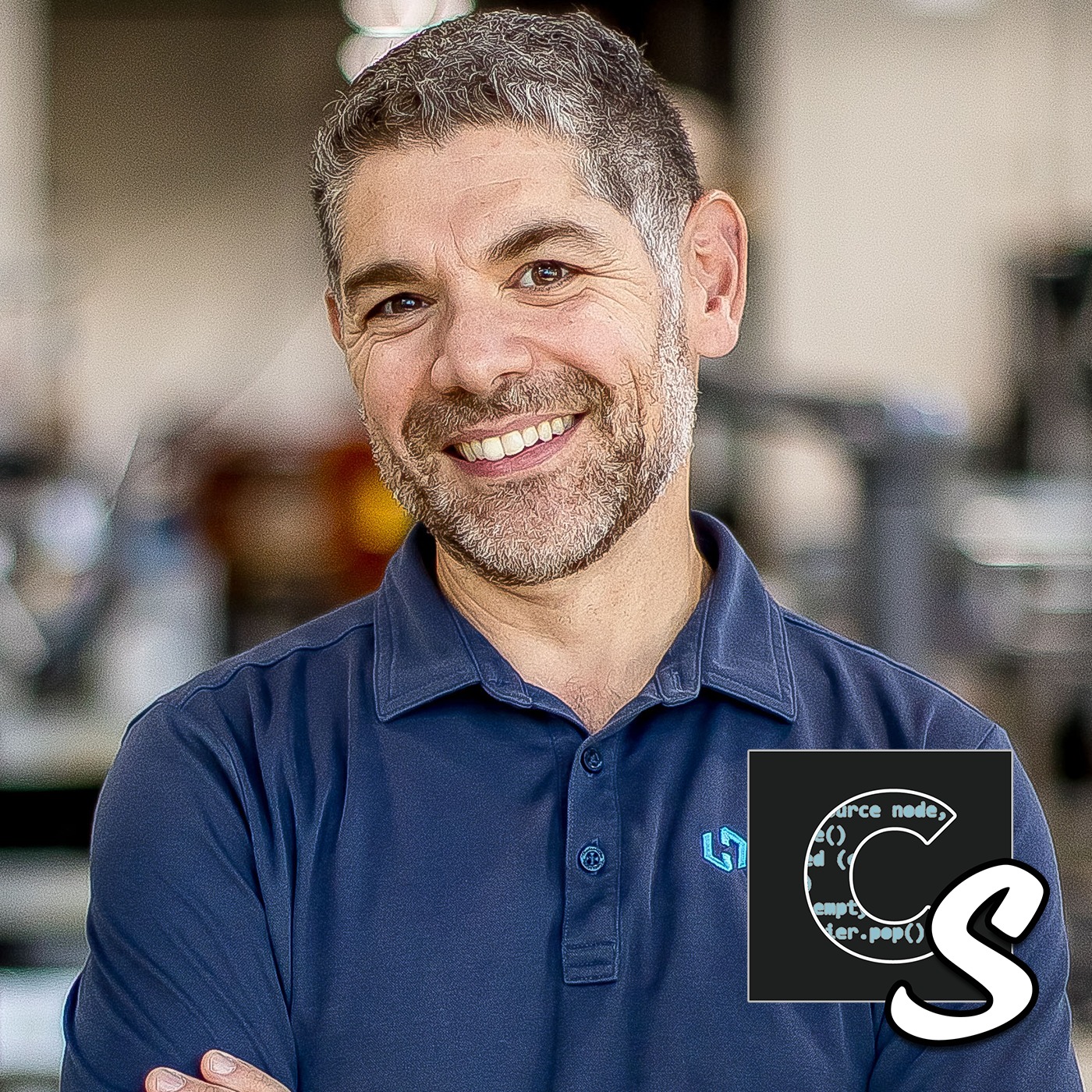
S13 Bonus: Factory Orchestration: Coordinating People, Processes and Machines in one Model, with David Caputo, Co-founder of Harmoni.io
In this episode
David Caputo is currently living in Tribeca, New York. He studied electrical engineers, but became interested in finance and investment banking through a fraternity buddy. During school, he would sneak into the business school to learn more about this industry, and eventually spent 10 years in this space before heading into private equity and the acquisition of plants and industrial operations - many of which he still owns and operates today. Outside of tech, he is married with 3 kids. He enjoys playing guitar in his so called "Dad Band", where he covers 90's songs, as well as following the OMAD program - IE one meal a day.
David experienced severe pain points in factory operations firsthand, when running the businesses he had acquired in the past. There were frequent instances of costly human error and knowledge loss between workers. He and his co-founder obsessed that the missing layer was a factory orchestration systems, to serve as the "glue" between people, machines, and enterprise systems.
This is the creation story of Harmoni.
Links
https://www.linkedin.com/in/david-caputo-52399499
Current Sponsors:
Checkout our Stacklist! https://stacks.codestory.co/
Check out our Patreon!
Hosted by Noah Labhart | Technical Founder & Startup Mentor.
Our Sponsors:
* Check out Granola and use my code granola.ai/CODESTORY for a great deal: https://granola.ai
Advertising Inquiries: https://redcircle.com/brands
Privacy & Opt-Out: https://redcircle.com/privacy
[SPEAKER_01]: Most factories are not the big, automated production lines that people envision when if you close your eyes and picture a factory. [SPEAKER_01]: Right? [SPEAKER_01]: A lot of times people picture a Toyota production line or something with a lot of advanced technology. [SPEAKER_01]: Most factories are actually very different than that. [SPEAKER_01]: There's 284,000 factories in this country.
[SPEAKER_01]: 90 plus percent of them have fewer than a hundred people who work in them and most of those factories don't have a single IT person who actually you know on staff deal with any kind of complex integrations or deployments or anything like that and so we designed the product to be very low friction and by that we call that our two plug model meaning you just plug it into power you plug it into the machine it just works. [SPEAKER_01]: My name is David Caputo and I'm co-founder of Hartman.
[SPEAKER_03]: This is code story, a podcast bringing you interviews with tech visionaries, six months moonlighting goes. [SPEAKER_03]: I'm lost in all the backgrounds, who share what it takes to change an industry. [SPEAKER_00]: I don't exactly know what to do. [SPEAKER_03]: It doesn't go as to get right. [SPEAKER_02]: who built the teams that have their bad company is its team's help each other, which is proud of our team. [SPEAKER_03]: Keeping scalability top of mind, all that infrastructure was up there.
[SPEAKER_03]: Yes, we've been fighting it as we grew up. [SPEAKER_03]: Total waste of time. [SPEAKER_02]: The stories you don't read in the headlines. [SPEAKER_02]: It's not an easy thing to achieve. [SPEAKER_03]: To get yourself a deficit of off, try to begin to ride the ups and downs of the start-up line. [SPEAKER_02]: To really want it. [SPEAKER_03]: Not just about technology. [SPEAKER_03]: All this and more on code story. [SPEAKER_03]: I'm your host, Snow Alapart, and today how David Caputo is making your factory work together, coordinating people, machines, and processes in harmony.
[SPEAKER_03]: David Caputo is currently living in Tribeca, New York. [SPEAKER_03]: He studied electrical engineering, but became interested in finance and investment banking through a fraternity buddy. [SPEAKER_03]: During school, he would sneak into the business school to learn more about this industry and eventually spent 10 years in the space before heading into private equity and the acquisition of plants and industrial operations, many of which he still owns and operates today. [SPEAKER_03]: But outside of Tech, he's married with three kids.
[SPEAKER_03]: In Joyce playing guitar in his so-called Dad Band, where he covers 90 songs, as well as following the O-MAD program, i.e. [SPEAKER_03]: one meal a day.
[SPEAKER_03]: David experienced several pain points in factory operations firsthand, when running the businesses he had acquired in the past. [SPEAKER_03]: There were frequent instances of costly human error and knowledge loss between workers. [SPEAKER_03]: He and his co-founder obsessed that the missing layer was a factory orchestration system to serve as the glue, quote unquote, between people, machines, and enterprise systems.
[SPEAKER_03]: This is the creation story of Harmony.
[SPEAKER_01]: Harmony was really built out of a need that I had. [SPEAKER_01]: I didn't want to build the company building company as a really hard way of solving a problem in hindsight. [SPEAKER_01]: But my initial inclination was to actually go and buy technology to help the factories that I own and operate in that fund run more efficiently. [SPEAKER_01]: And I'm talking about software to do everything from clocking it out for the day to automate that type of work [SPEAKER_01]: monitoring the equipment and the machines, to loading programs onto these machines and lowering digital work instructions, locating things in the factory floor, the tracking quality data, all of these areas were areas that were being handled manually in the factories that I had.
[SPEAKER_01]: And I just saw a ton of inefficiency and mistakes happening and we wanted to automate them and to prevent the mistakes from happening that were creating scrap of the shop floor. [SPEAKER_01]: Harmony was built to solve a gap that existed because the more of these tools I was adding, the more inefficiency I was actually adding into the factoring the more mistakes were actually being made because people haven't to enter data the same time in multiple systems and when you make the operative equipment, the middleware of all these products, you meant to inevitably make mistakes and it results in mistakes.
[SPEAKER_01]: And so, poverty is a factory orchestration system, and it does a lot of different things. [SPEAKER_01]: Back to orchestrations and new category of product, but the simplest way to think about it is there are three pillars to factory orchestration. [SPEAKER_01]: And the goal of these pillars are to simply automate non-productive work so that you have more productive time from operators, therefore you make more parts. [SPEAKER_01]: and to prevent mistakes that lead to scrap, resulting in less scrap the shopplor, two things that who doesn't want to do those two things, right?
[SPEAKER_01]: Anyone who wants a factory presumably wants to do them, but the way, after your Christian works is in unique ways. [SPEAKER_01]: So the three pillars are number one automation. [SPEAKER_01]: We automate non-productive time using [SPEAKER_01]: technologies like RFID, so you put RFID tags on operator badges on the jobs that they work on, and so when you walk up to a machine, it'll say, good morning, Noah, would you like to punch him for the day? [SPEAKER_01]: You tap the yes. [SPEAKER_01]: This is all being done through our device.
[SPEAKER_01]: It's a physical device, so the stalls at the work center, right? [SPEAKER_01]: It's got a touch screen. [SPEAKER_01]: It's an interactive product. [SPEAKER_01]: And so, you would tap yes, you want to clock in for the day, then it's as you're working on job XYZ, do you want to start operation 10 on this machine? [SPEAKER_01]: You tap yes, that transaction will happen in your ERP system. [SPEAKER_01]: And then you're off to the races, but the key thing is we now have the context of what you're doing.
[SPEAKER_01]: So the second pillar of Harvard, that was one example of automation. [SPEAKER_01]: We have a dozen plus different automations like that that they cut out non-productive time. [SPEAKER_01]: Then once we have that context of who you are, what you're working on, what machine you're at, we use it to power our second pillar, which is process control. [SPEAKER_01]: And so we're able to pull the correct work instructions in the correct program to run on the equipment that you're running on and the correct check sheet to take all the in-process measurements during the operation that you're working on.
[SPEAKER_01]: The whole goal of the process control pillars to prevent mistakes for somebody reading an outdated instruction that might be floating around the shop floor or using an old program that might be on a USB stick that operator has. [SPEAKER_01]: And so with Harmony, they're getting the latest Rev-controlled version of all this information, communicating any changes to the operator that might need to be communicated to prevent scrap from happening in that operation. [SPEAKER_01]: And the third pillar of factory orchestration is observed ability, which simply means you know what's going on in your factory.
[SPEAKER_01]: That's a lot harder than it sounds and most factories you walk around and everybody looks business, right? [SPEAKER_01]: And what does that actually mean for efficiency? [SPEAKER_01]: It's hard to tell, and usually you find out at the end of the week or the end of the month who's some kind of report when it's too late to do anything about it. [SPEAKER_01]: With harmony you could see visually and real time what's happening on the shop. [SPEAKER_01]: Floor so you could see these indicator lights on our devices as you look down the aisle and you can see green red.
[SPEAKER_01]: and then you can go there and the Harmony Terminal will show you exactly what's going wrong at this work center. [SPEAKER_01]: It could be somebody falling behind on right or the machine stand for some reason. [SPEAKER_01]: But either way, we're conveying the correct information that management needs to run a factor.
[SPEAKER_03]: I want to dive into the MBP for Harmony. [SPEAKER_03]: So the first version or first east that you built for the platform, along to take the build and what sort of tools were you using to bring it to life. [SPEAKER_01]: It took, I'd say, two to three years to actually have a MVP or what I'll say a production ready product. [SPEAKER_01]: We had a sandbox, if you define the MVP as something that runs in a sandbox, we probably had that in six months, but a big part of putting something into a factory is the regularization, and by that I don't just mean physical regularization, also the software and being able to deal with uncertain connectivity and environments and be a mission critical system, think of it almost like an autopilot on an aircraft.
[SPEAKER_01]: You really can't have downtime or outages or cases that you haven't thought about. [SPEAKER_01]: If you're going to use a device like this or a system like this in production where you are the only way of getting programs and instructions to operators, you do the only way of those operators punching and out of systems, it has to work. [SPEAKER_01]: And it was that ruggedization that I took most of the time. [SPEAKER_01]: Some of the tools that we were using in the early days really enabled the rapid prototyping run I said we had really a prototype in six months.
[SPEAKER_01]: Tools like Raspberry Pi boards they were instrumental in getting an IOT Linux based IOT device off the ground quickly, no red via the [SPEAKER_01]: kind of flow coding software that really allows you to kind of simply build some fairly complex logic, logic flows, and then also Altium for PCB designs. [SPEAKER_01]: We have our own custom hardware, and Altium software, and specifically they had a block, block design tool called Upverter, that was uniquely helpful in getting the first prototype PCBs created.
[SPEAKER_03]: want to stay on that for a minute, and I could probably cherry-pick a couple of things from what you said, but I'm curious about a decision or trade-off yet to make in that initial version. [SPEAKER_03]: Right, and how you approached it or things that you accepted, as far as maybe technical debt or limitations and features or things like that, and how you coped with those decisions. [SPEAKER_01]: I would say that the biggest early decision that was one of the most consequential decisions of our company was whether to build our own hardware or use off the shelf hardware.
[SPEAKER_01]: And we went with custom hardware, which obviously, when you're a two-person company myself and my co-founder, that was a much, much harder path than simply taking it off the shelf, PLC or SBC, loading our software and running off of that. [SPEAKER_01]: And frankly, most companies in our space and the kind of connected factory space go with off the shelf hardware, simply because it is just so much quicker and easier to get it up and running. [SPEAKER_01]: But the reason why this was one of the most important decisions we ever made is that a lot of the differentiators of our products such as RFID we have far field RFID embedded in the product we're able to identify operators jobs are really anything in a factory depend on custom hardware we have a TPU that's in all of our devices and we use a Google product the Google [SPEAKER_01]: Orl, Chip, and now we're using a Israeli product.
[SPEAKER_01]: It's a really advanced TPU. [SPEAKER_01]: It's got significant edge in France capabilities. [SPEAKER_01]: And to be able to have, there's many other hardware elements that allow us to talk to dozens of types of equipment and interface with other systems in the factory. [SPEAKER_01]: And all of that goes back to having custom hardware. [SPEAKER_01]: And so it probably added, [SPEAKER_01]: a year, maybe more, to that upfront MVP time, having to bring up hardware. [SPEAKER_01]: But it was worth it a thousand times over in the end.
[SPEAKER_03]: So let's move forward then. [SPEAKER_03]: How, from that point, how did you progress and mature the platform? [SPEAKER_03]: And I think to wrap that in a box a little bit when I look for it, how did you build your roadmap? [SPEAKER_03]: How did you go about deciding that okay? [SPEAKER_03]: This is the next most important thing to build, create or to address with harmony.
[SPEAKER_01]: So, the initial set of features of our system of this FACAR registration system were based on my own pain points. [SPEAKER_01]: And so, I could literally tell you a story about every one of the features that happened in my factory. [SPEAKER_01]: and how it resulted in either inefficiencies or scrap parts, and that then became a feature. [SPEAKER_01]: And almost 100% of the initial features tied back to a story. [SPEAKER_01]: But now those initial features make up a tiny fraction of the functionality of the product because what replaced my own stories are our customers, collective stories, and [SPEAKER_01]: Now the product is largely guided by the customers and it's an amazing thing where customers trust us to build in this functionality to meet all these different use cases and problems that we didn't even know existed just because you need a large sample size to actually understand kind of the different issues that can come up.
[SPEAKER_01]: And so just give an example of one [SPEAKER_01]: feature that was based on a problem that happened in one of my factories. [SPEAKER_01]: In one of my aerospace manufacturing factories, so we used to load programs using USB sticks, which almost all shops today actually use. [SPEAKER_01]: And an operators who run equipment, they go and get a copy of the program, from engineering, and then they go and take it to their machine and load it on that machine on a USB stick. [SPEAKER_01]: Or sometimes they have serial transfer devices that can get it from engineering, [SPEAKER_01]: But either way, once that program hits the shop floor, it then effectively becomes the property of that operator.
[SPEAKER_01]: and that the operator gets a new version whenever they go to engineering and request one. [SPEAKER_01]: And so there's a lot of obvious problems with that workflow, but the one that I never imagined a bit me pretty hard in my own factory was we had an operator running a part he had been making the same part for 10 plus years. [SPEAKER_01]: And then one great, a great employee, a great operator making a really complex part. [SPEAKER_01]: And then one day that operator retired and we threw him a party and it was great and we sent him off on his way.
[SPEAKER_01]: and then we went to go give the program to the next person who's gonna run that part. [SPEAKER_01]: And that person came back to shortly after and said, hey, this program was written for a machine that we owned 10 years ago and looks like it doesn't even make the same part. [SPEAKER_01]: It makes a sort of a variant of this part that looks nothing like the part that we're actually trying to make here. [SPEAKER_01]: And what we realized happened was over the course of this 10 years that operator had been [SPEAKER_01]: updating that program and making Chainty was a very good operator who would write the G-code himself right at the machine and had been updating and making changes to comply with not just rev changes to the part, but actually different equipment that had been bought over the years.
[SPEAKER_01]: And that program left with that operator. [SPEAKER_01]: There was no copy of that program. [SPEAKER_01]: anywhere within the factory and this operator moved back to Poland where he lived and we had no way to get a hold of him or find that program and so that that part had to be re-engineered and we lost a year of time. [SPEAKER_01]: Simply because we had no copy of the program that had left with this one operator and so that that particular part had to go through life fire testing and all kinds of [SPEAKER_01]: other certifications before it could then be used again by the customer and so it was a an immensely costly endeavor and so in harmony we have a feature called Program Change Detection where we can detect whether changes are made while programs are running automatically detect those and fire a change request back engineering when that happens.
[SPEAKER_01]: to ensure that any changes that are made along the way during the manufacturing process go back to the source of the system record and that the engineers who are responsible for that part can decide whether or not those changes are going to be accepted into the part. [SPEAKER_01]: And so it's a feature that was born out of a real pain point that I lived in experience and I could tell you stories like this all afternoon we probably don't have time on this podcast to go through them all but all of the initial features started with stories like that.
[SPEAKER_03]: Okay, I'm curious about team David, how did you build your team? [SPEAKER_03]: Would you look for in those people to indicate that they are the winning horses to join you? [SPEAKER_01]: Our M.O. [SPEAKER_01]: at Harmony is we want to have fewer smarter people and we are not, we are not the ones to go out there and talk about how big of a team we have and how we've added so many people in using Headcount as some sort of point of pride. [SPEAKER_01]: We actually, I actually think the biggest flex is what you can do with the fewest people.
[SPEAKER_01]: And what we look for is people who want to actually take ownership of what they're doing and not just work on a small piece of the pie. [SPEAKER_01]: Another unique aspect of harmony that plays into that is that we actually have no titles at heart. [SPEAKER_01]: And this is the decision that my co-founder and I made early on. [SPEAKER_01]: And the idea is that we want people who can work across functions and we want people to be valued based on the actual contributions that they make and not by the title that they commit.
[SPEAKER_01]: So for example, if you hire a junior engineer and you give them the title of junior engineer one. [SPEAKER_01]: And then they're working on a team with senior engineer 4 right in the traditional company where you have that hierarchy in this title. [SPEAKER_01]: That junior engineer 1 is going to defer to senior engineer 4 on decisions on, you know, they're going to follow the lead of that senior engineer and do things in the way that they're wanted to be done. [SPEAKER_01]: But, in reality, especially in today's world where a gentle coding is fundamentally transformed, how developers work.
[SPEAKER_01]: You might have junior engineer one stepping onto a team who can output 10 times the productivity of senior engineer four, who maybe has been slow to adopt AI or is using it in sort of non-optimal ways. [SPEAKER_01]: And that's a great example of how having no titles actually levels the playing field and it forces everybody to look at what each other are doing on the team and operate at a consistent level because at the end of the day when your value based on your performance and your output, it's not so much about the title anymore and it's about what you're actually doing.
[SPEAKER_01]: I think that helps drive innovation and collaboration among the teams and also allows people to work across teams. [SPEAKER_01]: You might have somebody who starts in development and says, gee, I'd like to also be a part of the customer's success team and understand what issues customers are having or sales engineering may be part of selling the product because they want to hear what are the features that customers most interested in. [SPEAKER_01]: And when you have a structure that's flexible, we call it our pod system and pods are similar
[SPEAKER_01]: pods and those pods basically just outline when area that you're working for example engineering or sales or marketing. [SPEAKER_01]: We also have project pods for special kind of collaborations that people to output it could be a product that needs cross-functional expertise or something along those lines and so that that type of structure allows for collaboration in unique ways and it's works really well for us.
[SPEAKER_03]: Let's move into scale and this will be interesting because you're combining hardware and software and how you're solving this problem I'm curious how you approach scale in the beginning and if there's been interesting areas where you've had to fight scale as you grow.
[SPEAKER_01]: When we designed this product from the early days, one of our guiding principles was that we wanted to reduce the friction to this product being installed in factories, because most factories are not the big automated production lines that people envision when if you close your eyes and picture a factory. [SPEAKER_01]: Right a lot of times people picture a Toyota production line or something with parts going down and [SPEAKER_01]: a lot of advanced technology. [SPEAKER_01]: Most factories are actually very different than that.
[SPEAKER_01]: There's 284,000 factories in this country. [SPEAKER_01]: And 90 plus percent of them have fewer than 100 people who work in them. [SPEAKER_01]: And most of those factories don't have a single IT person who actually, you know, on staff to deal with any kind of complex integrations or deployments or anything like that. [SPEAKER_01]: And so we designed the product to be [SPEAKER_01]: Very low friction, and by that we call that our two plug model, you just plug it into power, you plug it into the machine, it just works, it's pre-configured, it knows what's going on, and it doesn't require a big professional services deployment.
[SPEAKER_01]: We've already pre-built integrations and machine communications and all that type of stuff. [SPEAKER_01]: And so we didn't quite get to zero friction, at least not in the early days, we're getting a lot closer today, but that was a key design decision from the beginning to help with scale. [SPEAKER_01]: and because if your product becomes a professional services engagement, then you're naturally going to be limited on how quickly you can deploy it. [SPEAKER_01]: One of two things is going to happen.
[SPEAKER_01]: You're either going to have to charge customers a lot of money for that and staff up a very large professional service esteem that would it would end up consuming all of the employees in the company right? [SPEAKER_01]: It probably ends up being 90% of your headcount. [SPEAKER_01]: and this professional serves to seem to that be option one and we took option two where we spent again more time up front building to make this a very seamless install process and that really helped with early scale because it allowed us to actually focus less on integration and more on actually making sure this does what the customers actually want.
[SPEAKER_01]: And the second thing, the second decision that really affected scalability is that we decided early on that we are not going to run free pilots of this system. [SPEAKER_01]: And this was a very intentional decision. [SPEAKER_01]: And this is done because I firmly believe that your product is worth what a customer is willing to pay for it, including in a pilot stage. [SPEAKER_01]: And if a customer says, gee, I don't know if I see any value in this thing, but happy to slap it on that machine or put it up this work center and see if it doesn't anything about it.
[SPEAKER_01]: I think to expect something out of that or to expect any kind of commitment or engagement from the customer would not be the right expectation. [SPEAKER_01]: And so I think that if you run free pilots, you can probably scale very quickly and this probably slowed down. [SPEAKER_01]: I mean, probably could have had many more of these device load up the deal. [SPEAKER_01]: If we had been out there running free pilots and put new things wherever we could. [SPEAKER_01]: But I think that it drives the wrong type of behavior and so while that's a negative scaling decision, I think that it's one of the best decisions.
[SPEAKER_01]: Similar to the hardware decision, I think it's one of the best decisions we made as a company.
[SPEAKER_03]: As you step it on the balcony, then you look across all that you've built thus far with harmony. [SPEAKER_03]: What are you most proud of? [SPEAKER_01]: So this is a funny one. [SPEAKER_01]: This is not a, it's not, [SPEAKER_01]: the typical metric like a growth rate or hitting some ARR number or anything of the sorts or head count. [SPEAKER_01]: For me, the most proud, my most proud statistic of harmony is that we have not had a single customer chart since our inception. [SPEAKER_01]: And we're still a young company, we've been in market for three years, and I'm sure this will happen at some point.
[SPEAKER_01]: But I just think that it speaks to the fact that our customers actually want this product and are getting real value out of it on their shop floor. [SPEAKER_01]: And it's not an easy statistic to manage. [SPEAKER_01]: I think it's the hardest statistic that we manage because you have to actually listen to what matters to your customers and understand [SPEAKER_01]: where things are working, where things aren't working. [SPEAKER_01]: When they're not working, you make them right. [SPEAKER_01]: And you make sure that they do work.
[SPEAKER_01]: And you have to spend the time up front, making sure that it's getting implement to properly. [SPEAKER_01]: And sometimes that means taking and choosing who are your customers and who you want as your customers. [SPEAKER_01]: Because if you see something that's not a good fit, even if you have a customer willing to put your product in their factory and willing to pay you for it, pay you well for it, that doesn't mean you should. [SPEAKER_01]: and in fact the disruption from putting a product like this in a factory can be pretty significant if it's not a fit or if a customer is not engaged.
[SPEAKER_01]: And so it's a very hard statistic to manage, but it's the one that I'm most proud of.
[SPEAKER_01]: This one probably dates back to our very first customer, and it wasn't the smoothest process to get rolled out in our first customer, because while we thought we had a product that was ready, and you realize pretty quickly when you get out in the wild, that there's just so many scenarios that you haven't accounted for. [SPEAKER_01]: And the biggest mistake that we made was we knew, and I mentioned that a lot of the product, [SPEAKER_01]: was in the early days of my customers. [SPEAKER_01]: And one of the piece of feedback we got from this early customer was that we need to have dashboards.
[SPEAKER_01]: We need to have a way of showing management what's going on. [SPEAKER_01]: This can't just be a tool for the operators. [SPEAKER_01]: We got to deliver value to the management. [SPEAKER_01]: So we wholeheartedly agreed with that and decided to build out dashboards. [SPEAKER_01]: We thought that we were going to be really clever about it and not just build dashboards, [SPEAKER_01]: these customizable, configurable dashboards. [SPEAKER_01]: You could put whatever widgets you want on this dashboard.
[SPEAKER_01]: I want to see a chart of utilization over time. [SPEAKER_01]: I want to see a chart of labor hours and charging over time. [SPEAKER_01]: I want to see a table of all my top jobs. [SPEAKER_01]: And we made this really extensible, configurable dashboard. [SPEAKER_01]: And we brought it to the customer and said, see, we heard you look at what we built, isn't it so amazing? [SPEAKER_01]: And we kind of got crickets for feedback, and we were sitting back wondering, what's going on? [SPEAKER_01]: This is the most novel dashboard, and he was ever seen.
[SPEAKER_01]: And then eventually, when we finally were able to get real feedback from the customer, what we heard was, [SPEAKER_01]: This is just too complicated. [SPEAKER_01]: I just want to log in, see a dashboard, and just see the charts that I need to see. [SPEAKER_01]: I don't want to have to create these charts. [SPEAKER_01]: I don't know what I need to care about. [SPEAKER_01]: I was expecting to come in and see a bunch of charts, and you guys tell me what I should care about. [SPEAKER_01]: And it was this novel concept of complexity doesn't mean better and configurability doesn't mean better.
[SPEAKER_01]: better is what customers want, and in this case, we only heard half of what they want. [SPEAKER_01]: They want to dashboards, but they want to dashboards that just showed them what they need to care about. [SPEAKER_01]: They didn't want to have to sit down and decide what should I care about. [SPEAKER_01]: And so that was a really tough lesson. [SPEAKER_01]: And we obviously went back to the drawing board and created an entirely different type of dashboard interface and charts, but everything was pre-based.
[SPEAKER_01]: And it was all set up to show them exactly what they needed to see and care about. [SPEAKER_01]: And it took a lot of thinking and planning on our part to come up with it. [SPEAKER_01]: But I fully understood at that point why the customer wouldn't want it.
[SPEAKER_03]: Let's move forward then. [SPEAKER_03]: This will be really exciting. [SPEAKER_03]: Harmony is an amazing platform. [SPEAKER_03]: Incredible solution. [SPEAKER_03]: You're changing things with software and the hardware pairing that you have. [SPEAKER_03]: What does the future look like for Harmony for? [SPEAKER_03]: The platform, the products for the team, the industry's moving fast AI, all the things, right? [SPEAKER_03]: How many of the future looks like? [SPEAKER_01]: Well, of course, you must have known where I was going with this, but we also have our AI product that was actually recently announced, so in September last month, we announced how, which is the Harmony AI Lieutenant, and this is our AI agent, but this is a, this is a very unique AI agent, this isn't just yet another chatbot that, [SPEAKER_01]: get strapped onto a product in the cloud, although we do have a cloud interface for how management can log in and get access to all kinds of information, shop-wide-level, including machine data, and engineering data, and ERP data, RFID data, locating items throughout the shop, and people in jobs.
[SPEAKER_01]: So yes, there is a cloud interface to it, but what's really novel about how is that we're delivering AI right at the front lines of manufacturer. [SPEAKER_01]: So this is context of where AI delivered at the point of production through the interface being our device and you're able to actually talk to it so you hold the indicator light and speed to the device as if you're literally speaking to your machine or your work center and you can say something as simple as, hey, how wise my tool chattering.
[SPEAKER_01]: and how to understand who you are, what job you're working on, therefore what part you're making, which machine you're at, what type of machine is, what the specs are of that machine, what instructions were followed when you set up that machine, what program is running on the machine, what line of the program it's at, how the last 10 runs have gone, what the check data, the inspection data that you've taken so far from that from those parts produced are, are they trending in or out of tolerance, [SPEAKER_01]: out as I compared to the last 10 runs, I could keep going.
[SPEAKER_01]: There is hundreds of pieces of context that are that are automatically available when you ask a simple question like why is my tool chattering and it's able to solve problems that have never before been solvable right at the front lines of manufacturing so that it is a really exciting area. [SPEAKER_01]: And in addition to that, we are not a AI-only company. [SPEAKER_01]: We're delivering a lot of value through factory orchestration. [SPEAKER_01]: And we're continuing to expand the footprint of that.
[SPEAKER_01]: For example, we've added features like tool-like management and scheduling. [SPEAKER_01]: Again, all the get-managed right at the front line. [SPEAKER_01]: So operators have everything they need right at their work center. [SPEAKER_01]: So lots of expansion on the core product and most of that customer driven. [SPEAKER_01]: But our big exciting recent launch was Hal. [SPEAKER_03]: able to switch to you. [SPEAKER_03]: Who influences the way that you work? [SPEAKER_03]: Name a person or many persons or something.
[SPEAKER_03]: You look up to him. [SPEAKER_03]: Why? [SPEAKER_01]: This one's probably going to be a bit of a controversial pick, but I'm going to go with Elon Musk. [SPEAKER_01]: And I wish he wasn't a controversial pick, but I graduated the luxury engineering at a time when engineering just wasn't cool. [SPEAKER_01]: It was right after [SPEAKER_01]: the dot com bubble had burst and I got pulled in other directions that sounded great and exciting at the time and they were and they were very foundational to my career and allow me to do what I do today.
[SPEAKER_01]: But the way Elon has approached building businesses and the intimate tie-in with [SPEAKER_01]: the engineering involved in building those businesses, being involved down to the point of design, living on the factory floor and showing that being an engineer is not just a great way to make a living, but can be really fun, exciting, and you can build products that people think are not possible. [SPEAKER_01]: Like at the time when electric cars were thought of as being something that just
[SPEAKER_01]: and that can meet a price point that is commercial. [SPEAKER_01]: And when building rockets was never something that people thought of as a private industry endeavor, sure enough, he made a very viable private rocket launch. [SPEAKER_01]: He company and started a whole trend around that and really brought back the excitement around space, space travel. [SPEAKER_01]: And so he's shown that if you really dedicate yourself to something that you can do things that actually change the world.
[SPEAKER_03]: Okay David, last question, so you're getting on a plane. [SPEAKER_03]: You're sitting next to a young entrepreneur who's built the next big thing. [SPEAKER_03]: They're jazzed about it. [SPEAKER_03]: Can't we show it off to the world and can we show it off to you right there on a plane? [SPEAKER_03]: What advice do you give that person having gone down this road a bit? [SPEAKER_01]: What I would tell them is that if you truly believe that you have an idea that can change an industry and you're genuinely passionate about that industry.
[SPEAKER_01]: than doing. [SPEAKER_01]: You have no choice. [SPEAKER_01]: You have to do it. [SPEAKER_01]: You're going to do it anyway, whether I tell you to do it or not. [SPEAKER_01]: But my advice would be to do it. [SPEAKER_01]: But if you're doing it because you think there's a hot area or unique opportunity to kind of get into something and the goal is a big valuation or a big pay day, I would say skip it because if it's about the money or the recognition, there's easier ways to make money and to get recognition much easier ways than starting a company from scratch.
[SPEAKER_01]: And it's that genuine passion for whatever the industry is that you're working in that's going to get you through those times. [SPEAKER_01]: But if you're just chasing the valuations or the recognition, you're inevitably going to give up somewhere along the way during one of those lows. [SPEAKER_01]: And so that would be my advice. [SPEAKER_03]: I think that's absolutely fantastic advice. [SPEAKER_03]: They would thank you for being on the show today and thank you for telling the creation story of harmony.
[SPEAKER_03]: Thank you for having me. [SPEAKER_03]: and this concludes another chapter of Code Story.
[SPEAKER_03]: Code Story is hosted and produced by Noah Laphardt. [SPEAKER_03]: Be sure to subscribe on Apple Podcast, Spotify, or the podcasting app at your choice. [SPEAKER_03]: And when you get a chance, leave us a review. [SPEAKER_03]: Both things help us out tremendously.
[SPEAKER_03]: And thanks again for listening.
Latest Season of the Podcast is Sponsored By


 Apple Podcasts
 Spotify
 Castbox
 Player FM
 Pocket Casts
 YouTube
 Overcast
 Castro
 Goodpods
 Moon FM
 Podbean
 Podcast Addict
 Podcast Republic