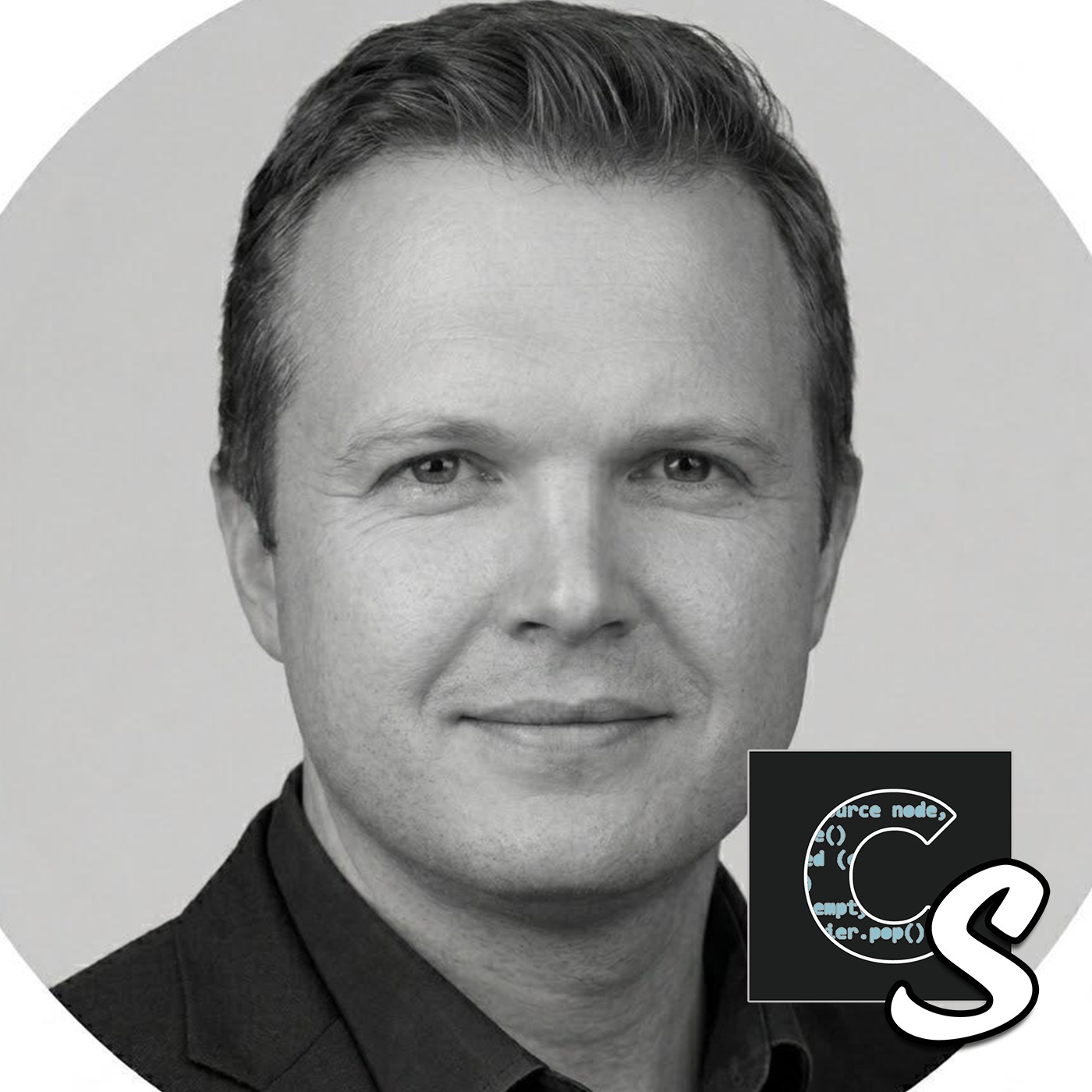
S12 Bonus: The Microsoft File Trap: Moving Beyond Manual PowerPoint and Excel Workflows to Build an AI-Native "Consulting" Layer with Tim Lidman, Co-Founder & CEO of Clyde AI
In this episode
Tim Lidman lives in Denver, CO. He has had an unconventional path to being a Tech CEO. In fact, He moved from London to Sweden when he was 18... to try to be a heavy metal rock star, trying to make it big as a drummer. To earn extra income, he got into tech sales - which went really well. Eventually, he worked with WebEx (around the time it got bought by Cisco), for Success Factors (when they got bought by SAP), and then eventually, doing his own startup (which eventually got bought by Accenture). Outside of his professional life, he is married with 2 girls. From his music years, he extracts skills that drove his success to date, which is the ability to product development and execution down the same way you do music.
In the days of his first startup, Tim's solution was used by consulting firms to power client engagement. Post exit, while overseeing things at Accenture, he noticed that the whole industry was powered by Microsoft files (PowerPoint, Excel, Word, etc.) - IE, driven manually. He started to wonder if he could codify the consulting process, to remove the manual burden.
This is the creation story of Clyde.
Sponsors
Links
Current Sponsors:
Checkout our Stacklist! https://stacks.codestory.co/
Check out our Patreon!
Hosted by Noah Labhart | Technical Founder & Startup Mentor.
Our Sponsors:
* Check out Granola and use my code granola.ai/CODESTORY for a great deal: https://granola.ai
* Check out Perplexity and use my code pplx.ai/codestory for a great deal: https://www.perplexity.ai
Advertising Inquiries: https://redcircle.com/brands
Privacy & Opt-Out: https://redcircle.com/privacy
[SPEAKER_01]: I think we got ahead of ourselves on using AI to generate just insane amounts of code. [SPEAKER_01]: We were pushing so fast. [SPEAKER_01]: We unintentionally created some tech debt by just generating tens of thousands of lines of code all of the time. [SPEAKER_01]: We ended up with this delta of generated code and then truly understanding what was in that code base. [SPEAKER_01]: And so that required us to take a step back what we did is we actually took a about a four week period migrated over or the existing functionality added new functionality on top and we did that as a way to almost completely clean up our tech that.
[SPEAKER_01]: My name is Tim Lidman and I'm the co-founder and CEO of Clydea.
[SPEAKER_02]: This is Code Story. [SPEAKER_02]: a podcast bringing you interviews with tech visionaries. [SPEAKER_02]: Six, six months moonlighting goes. [SPEAKER_02]: It's the last and all of the backgrounds who share what it takes to change an industry. [SPEAKER_00]: I don't exactly know what to do. [SPEAKER_02]: It's the same goes to get right. [SPEAKER_03]: who built the teams that have their bad company is its team's help each other, a team's proud of her team. [SPEAKER_02]: Keeping scalability top of mind, all that infrastructure was up there.
[SPEAKER_02]: Yes, we've been fighting it as we grow. [SPEAKER_02]: Total waste of time. [SPEAKER_03]: The stories you don't read in the headlines. [SPEAKER_03]: It's not an easy thing to achieve. [SPEAKER_02]: To get yourself a deficit of off, try to begin to ride the ups and downs of the start-up line. [SPEAKER_03]: Need to really want it. [SPEAKER_02]: Not just about technology. [SPEAKER_02]: All this and more on code story. [SPEAKER_02]: I'm your host Noah Labpart, and today how Tim Lidman is enabling you to collaborate with AI the same way you collaborate with real people.
[SPEAKER_02]: Tim Lidman lives in Denver, Colorado. [SPEAKER_02]: He has had an unconventional path to being a tech CEO. [SPEAKER_02]: In fact, he moved from London to Sweden when he was 18, to try to be a heavy metal rock star. [SPEAKER_02]: To earn extra income, he got into tech sales, which went really well. [SPEAKER_02]: Eventually, he worked with WebEx, around the time he got bought by Cisco. [SPEAKER_02]: for success factors when they got bought by SAP, and then eventually doing his own startup, which eventually got bought by Accenture.
[SPEAKER_02]: Outside of his professional life, he's married with two girls, from his music years he extracts skills that drove his success to date, which is the ability to break down product development and execution the same way you do music.
[SPEAKER_02]: In the days of his first startup, Tim's solution was used by consulting firms to power client engagement. [SPEAKER_02]: Post exit while overseeing things at Accenture, he noticed that the whole industry was powered by Microsoft files, PowerPoint Excel, Word, et cetera, IE-driven manually. [SPEAKER_02]: He started to wonder if he could codify the consulting process to remove the manual burden.
[SPEAKER_02]: This is the creation story of Clyde,
[SPEAKER_01]: To help you understand what Clyde is, I'll probably start by explaining why we created it, which takes us back to the first startup that I ran. [SPEAKER_01]: What Think Tank was is it was a collaboration platform that primarily helped consulting firms drive client engagements and client workshops. [SPEAKER_01]: So, instead of showing up with a myriad of tools like PowerPoint, Excel, Miro, Whiteboards, you would show up with Think Tank, which was a structured collaboration tool that really helped you guide a group of people from ideas to outcomes or challenges to outcomes.
[SPEAKER_01]: It was based on decades of research in behavioral science and how groups come together to align and make decisions, and then the product in the UX side, it kind of put on top of that research to then create this experience that, you know, if you consider the collaboration industry at its progression and that's the industry I grew up in. [SPEAKER_01]: I noticed that there was this shift from just enabling people to connect remotely and to facilitate communication, to being much more intentional about collaboration and the outcomes that are intended coming out from my collaboration.
[SPEAKER_01]: And so we ended up being used by the world's largest consulting firms and the host of UT consulting firms. [SPEAKER_01]: And they really used it to power all of their client engagement. [SPEAKER_01]: And we became strategic to the point where we were embedded in billions of dollars of different bids as a main differentiator when they were going to market. [SPEAKER_01]: And so then in 2021 Accenture bought us and took us off to market. [SPEAKER_01]: All their competitors were using us.
[SPEAKER_01]: They were the second largest user. [SPEAKER_01]: First largest user was the remaining competitor. [SPEAKER_01]: And then I operated at Accenture as a partner for about four years in El Versa and led the Postmajorian immigration of think tank and so on. [SPEAKER_01]: This is where, if we start talking about why Clyde was created, when I was at Accenture, I started to see the deep kind of underbellion and the nuts and bolts of how consulting was operating. [SPEAKER_01]: And it surprised me to some extent the whole industry was being powered by Excel, PowerPoint, and SharePoint.
[SPEAKER_01]: When Jenny A. I hit, I started thinking about some of the limitations that I had when I was running the thick tank and one of the limitations I had running think tank was you still required a very human heavy sort of manual effort to get through the consulting workflow so you still had to design the client engagements you had to facilitate them synthesize all the information often in real time. [SPEAKER_01]: and then there's like a poor analyst that's up to two, three in the morning, putting together the final client deliverable.
[SPEAKER_01]: And so I thought, with AI technology becoming one, advanced, could I basically codify the workflow of consulting delivery into an AI and use an AI native sort of approach to develop a product that would take away extremely large amounts of [SPEAKER_01]: left eccentric to then set out to go do just that. [SPEAKER_01]: So what we did is we then grazed very small amount of money and went and built an MDP. [SPEAKER_01]: And we'll glue my mind, just talking about the A&A world we're in, to build the think tank version that got acquired, cost us about two million bucks and 18 months.
[SPEAKER_01]: We built the MVP for 250K and three months. [SPEAKER_01]: And obviously we're leveraging the full sort of AI coding stack, which has become more and more advanced, but just the efficiencies we were able to drive by having our developers generate,
[SPEAKER_01]: And what we found was that, of course, the consultants were very pleased to have someone build an AI tool for them. [SPEAKER_01]: I had many senior consulting leaders that said, oh, we're so busy building ages for all our clients that no one's building it for us. [SPEAKER_01]: Luckily, they had already had about two or three years to try to build home-grown AI tools, which was mainly just slapping an AI assistant on top of their knowledge business. [SPEAKER_01]: They realized that someone who deeply understands them as users and the UX that needs to enable them, but felt really, effortfully good to be able to focus in on that expertise.
[SPEAKER_01]: The other kind of feedback that we were getting quite often was that the world of product and professional services. [SPEAKER_01]: are like oil and vinegar, right? [SPEAKER_01]: Like, product people don't really understand service as a vice versa. [SPEAKER_01]: Product people have to say, no, 999 times and yes, once consultants have to say yes, 999 times. [SPEAKER_01]: And no, it's, so there's just this fundamental oil and vinegar thing going on. [SPEAKER_01]: And so the fact that our team and our expertise was sitting in the venn diagram between those two, I think kind of gives us an interesting kind of edge.
[SPEAKER_01]: But lastly, where we're at right now is we fully commercially launched the product in April of this year. [SPEAKER_01]: So two months ago. [SPEAKER_01]: what we've now seen is a really interesting, unintended kind of outcome of watching this. [SPEAKER_01]: We're seeing that in addition to consultants signing up, we have about 1700 people that have signed up where percentages of these users in use cases are outside of traditional consulting. [SPEAKER_01]: people that have a problem and they need a workflow that they can collaboratively work with to get them to a very specific outcome.
[SPEAKER_01]: We've had health care professionals, we've had school teachers that are basically saying I've never had access to a $500,000 McKinsey consultant. [SPEAKER_01]: Now I can use this to drive me to a $500,000 quality outcome of how to improve my curriculum for my students. [SPEAKER_01]: We're seeing this unintended outcome of almost democratizing consulting, which I didn't think was going to happen for at least two, three years. [SPEAKER_01]: I thought we were going to be focusing 100% on consulting firms, but it turns out we've gone broader faster than I thought.
[SPEAKER_02]: going to dive into all sort of areas of that overview that you touched on. [SPEAKER_02]: Right now, I kind of want to stay on, you know, what you would consider the MVP that first version of Clyde that you that you built, how long did it take you to build to bring it to life and what's sort of tools or methodologies were you using to bring it to inception.
[SPEAKER_01]: The first, we called it, that we ended up calling it the private MVP. [SPEAKER_01]: That took us about three, three months to build that first version of the product that worked end-to-end and could achieve its use case. [SPEAKER_01]: A few approaches that we took that made us operate or built that quickly is one, just from an architecture standpoint. [SPEAKER_01]: We decided to build on a serverless architecture on Google Cloud. [SPEAKER_01]: leveraging their backend using Cloud Functions and then using React on the front end to just very quickly be able to iterate.
[SPEAKER_01]: The other thing that we very quickly did is we started using Vibocoding. [SPEAKER_01]: Very early on before it became as mainstream as it is now. [SPEAKER_01]: I think the most powerful way we used that was our CPO, my co-founder, she's also a non-technical, a heavy expert in the use case and consulting. [SPEAKER_01]: And we thought we were going to have to hire a head of UX, but she ended up becoming so good at ViveCoding. [SPEAKER_01]: that she built all of our UX inside of lovable and then she built it in a way where she was using a combination of lovable and cloud to prompt lovable in a way that it didn't just develop prototype example mockups, it built the actual react components so that our developers could just lift and shift it from lovable into our development environment.
[SPEAKER_01]: and that saved us incredible amount of time. [SPEAKER_01]: And what's wild to me is, if I were to set that to you six months ago, that would have sounded really innovative, whereas now I feel like it's table stakes. [SPEAKER_01]: And that was just using by-putting to build their UXs, flows by mind how fast the industry progresses. [SPEAKER_01]: And then, once the MVP was out, and we wanted to start iterating, that was right when the Ralph Wiggum Loops was becoming really popular. [SPEAKER_01]: And that's when we moved from pair programming with AI and having AI generate code to actually deploying ambient agents to actually go and automatically pull our tickets from Jira.
[SPEAKER_01]: Go Ralph loop it as we call it overnight. [SPEAKER_01]: And then devs come back and check and put up the PRs. [SPEAKER_01]: And that's the process that we've now evolved to, where our devs are simply managing agents at this point.
[SPEAKER_02]: where when a head next is how you progress and matured it, you kind of touched on that a little bit, but I want to take it even further into today, like how you've progressed and matured it, since that MVP point. [SPEAKER_02]: And then, you know, to wrap it in a box a little bit, what I'm looking for is, how do you go about building your roadmap? [SPEAKER_02]: How do you decide that, okay, this is the next most important thing to build or to address with Clyde.
[SPEAKER_01]: To get to the MVP, we used the fact that both myself and my co-founder have some pretty deep industry expertise and kind of used ourselves as the requirement of the customer. [SPEAKER_01]: Once we launched and as we're now maturing the product, we've switched to heavily relying on our users, really trying to replicate the successful kind of product that growth successes that we've seen in the last couple of years out there. [SPEAKER_01]: And so we've implemented some pretty heavy analytics on top of our our databases where we've actually put AI on top of it and plugged it in so that we can have conversations with our data and our users, which is conversational.
[SPEAKER_01]: Every week I sit down and just start interrogating what our users are telling us, what they're using it for, I extrapolate the value that they're
[SPEAKER_01]: And that's done a pretty good job of giving us a very clear roadmap of where we need to be prioritizing. [SPEAKER_01]: When your features, we have a big release coming out in a few weeks where that's entirely driven by what our initial users had to say about the product of the release. [SPEAKER_01]: So have heavily user-driven, then on iterating our actual development workflow. [SPEAKER_01]: The other thing we realized from Sweet Launched is we were starting to get so many different.
[SPEAKER_01]: variations of how Clyde was responding to different user prompts and the sort of adaptive dynamic nature product that in order to keep up with the quality at scale, we just finished implementing evils. [SPEAKER_01]: That has further evolved our workflow to the point where we can now approach even the AI native parts of our product with a full test-driven development methodology. [SPEAKER_01]: And so we're basically writing, writing evilscripts, running them, and then gapment analyzing, adjusting, and that's really helped us dramatically speed up the iterations that we can get there.
[SPEAKER_02]: So I'm curious about, T, how did you go about building that team? [SPEAKER_02]: What do you look for in those people to indicate that they were the winning horses to join you? [SPEAKER_01]: We had a small little founding group of three people that we since doubled. [SPEAKER_01]: The first three of the founding three are people that I've known and worked with for 10 years. [SPEAKER_01]: Their people I deeply trust and I just have inherently built just so much trust with them over the years that I just deeply intimately knowledgeable about how they could support and how they would win.
[SPEAKER_01]: the new team members that we've hired. [SPEAKER_01]: I think we looked for a few things, so they've mainly been developers, so two developers in one marketing resource. [SPEAKER_01]: I looked for people that first off were fundamentally a-in-a-native, people that have since day one of Jenny I hitting the scene, Bing. [SPEAKER_01]: innovating using it, applying it, and so the interview process we asked for concrete examples of where they've used AI successfully, where they see it going.
[SPEAKER_01]: So I think that was one big component. [SPEAKER_01]: I think the second one is we're in AI native collaboration tool. [SPEAKER_01]: So collaboration is [SPEAKER_01]: at the heart of what we're about and to the point where the philosophies baked into our product. [SPEAKER_01]: And so you can have to be inherently collaborative to be successful in our team. [SPEAKER_01]: And so we looked for people that don't mind being in a highly unstructured collaborative environment. [SPEAKER_01]: In fact, one of our developers just and we absolutely love has almost become a forward-to-played engineer because he understands the use case and can interact with users almost as if he was a [SPEAKER_01]: So, yeah, collaborative, very cross-functional willing to go beyond specific kind of rules and definitions.
[SPEAKER_02]: Let's switch into scalability, and this will be interesting, given what you're building, and the framework that's underneath it, the foundation that's underneath it, I'm curious if how you've approached scale in the beginning. [SPEAKER_02]: And if there's, if there's been interesting areas where you've had to fight it as you've crowning, that could be overarching technology, it can also be business and people, all the things I'm curious about. [SPEAKER_02]: Any interesting stories around scale?
[SPEAKER_01]: One is around this very topical topic of token scarcity. [SPEAKER_01]: I'm not sure how much you've been written about that, but the last week, two weeks, everyone is starting to talk about how the industry overall is moving from being heavily subsidized by the frontier models and all of the growth capital that's being pumped into there. [SPEAKER_01]: to now shifting to where tokens actually become a scarcity and you start having to think about almost the business case of how you're going to use tokens and we've actually deeply thought about that and surfaced it into our product and so one one thing that happens when you use Clyde is Clyde extracts the context from you in terms of what you're trying to do the problem you're trying to solve in this sort of very structured way.
[SPEAKER_01]: And then in the background, Clyde will identify what model [SPEAKER_01]: is should I be using here to solve for this problem? [SPEAKER_01]: Do I need to, I need Opus 5.8, or can I do this with Gemini Flash, Hiku, and our multi-olem architecture that's going on in the back end allows us to on a weekly basis optimize how we're doing our model selection and not put that on us on the user. [SPEAKER_01]: Because one of the big challenges right now that I hear a lot of CIO is talking about [SPEAKER_01]: this fear of just unleashing all these really expensive reasoning models on users that don't really know how to optimize for it and so the reason I think that's really relevant to scale is one of my nightmares when I started was if at some point do all kind of AI native startups become financially unviable.
[SPEAKER_01]: if the ground shifts under you with the frontier models. [SPEAKER_01]: So, model optimization is one big thing with thinking about. [SPEAKER_01]: The other one we're thinking about is openweight models. [SPEAKER_01]: So, we've started testing and experimenting with if the time comes where we would have to rely on openweight models. [SPEAKER_01]: What part of our use case could handle that? [SPEAKER_01]: And then do we get to a point where we can open openweight models and find tune on top of it and not have to rely on.
[SPEAKER_01]: the frontier models for every less bit of our, of our product.
[SPEAKER_02]: Tim, as you step out on the balcony and you look across all that you've built thus far with Clyde, what are you most proud of? [SPEAKER_01]: I think I'm most proud of two things. [SPEAKER_01]: What is market facing and when is an internal facing? [SPEAKER_01]: On the internal facing one, I am exceptionally proud of our team and that we've been able to truly execute on this tiny team concept. [SPEAKER_01]: So, we decided pretty early on that we were going to keep this team as a lean as humanly possible, right?
[SPEAKER_01]: There's six of us operating the company right now. [SPEAKER_01]: And I think the fact that the team has been able to keep up with the levels of innovation going on constantly adapting their workflows and then learning to collaborate with non-technical founders and the technical, we've been able to operate as one team. [SPEAKER_01]: and there's no silo at all between the technical and the non-technical side of the house. [SPEAKER_01]: To the point where we're going to need to use those terms, I'm just really proud of the team internally.
[SPEAKER_01]: Externally, I think there's a zoomed out narrative right now where I'm sure you've heard the term that Sass is dead, right? [SPEAKER_01]: And the Sass Pocalypse and all these articles we've posted about that. [SPEAKER_01]: One of the promises of the LLM, just and the frontier models, has been that you don't have to [SPEAKER_01]: my paradigms in the way that you've had to learn SaaS paradigms to get benefit. [SPEAKER_01]: You can just talk to me naturally and I'll be able to know what you're trying to achieve and then it's on me as an LLM or for tear model to surface back the most elegant solution.
[SPEAKER_01]: I think that's problematic in one way because I don't think it's true. [SPEAKER_01]: I think that we are having to adapt [SPEAKER_01]: to the LLMs. [SPEAKER_01]: We are having to learn about context-engineering, right, prompt-engineering. [SPEAKER_01]: And one thing I'm really proud of with Clyde is we've built it in a way where we're not putting the context on the user. [SPEAKER_01]: We're building something inherently extracts the content from the user. [SPEAKER_01]: helps the user understand when they need to engage with human beings to solve their problem, which you can collaborate and do in our product, and when you need to use AI and what you need to use that AI form.
[SPEAKER_01]: So I'm really proud of actually enabling people and hopefully the world with tools that they truly natively can use in a natural sort of collaborative way, as us humans
[SPEAKER_02]: Let's flip the script a little bit. [SPEAKER_02]: Tell me about a mistake you made, and how you and your team responded to it. [SPEAKER_01]: We made a couple of mistakes when we were building, but we conversely launched. [SPEAKER_01]: One mistake is, I think we got ahead of ourselves. [SPEAKER_01]: Ahead of our skis may be a little bit on using AI to generate just insane amounts of code, right? [SPEAKER_01]: Like we were pushing so fast that we unintentionally created some tech dead by just generating tens of thousands of lines of code all of the time.
[SPEAKER_01]: generated code and then truly understanding what was in that code base and so that required us to take a step back and after we launched what we did is we actually took a about a four-week period as part of building the new release of Clyde that's coming out. [SPEAKER_01]: We actually deployed an entirely new sort of monorepo and migrated over the existing functionality added new functionality on top [SPEAKER_01]: and we did that as a way to almost completely clean up our tech debt.
[SPEAKER_01]: Getting ahead of that tech debt has just been really important. [SPEAKER_01]: I think another area where we, I don't know, fail the storyboard, but certainly had some inefficiencies, is before we implemented e-vails, we were doing a lot of, I'll just call it, trial and error development, prompt tweaking and trying to constantly refer back between the prompt, the graphs, the code, and that trial and error took us a long time sometimes to figure out root causes of issues that I think we could have done a lot faster.
[SPEAKER_02]: let's move forward then. [SPEAKER_02]: This will be exciting. [SPEAKER_02]: What is the future look like for Clyde or the product for your team, for the industry, where you think things are going all, all those things really, what is the future look like? [SPEAKER_01]: Wow, I could talk about any level of extraction there. [SPEAKER_01]: I think if I start looking at it, big picture. [SPEAKER_01]: I think I mentioned this unintended consequence of democratizing consulting. [SPEAKER_01]: I think people talk a lot about the death of consulting.
[SPEAKER_01]: There's a lot of articles out there that like to talk about how trillion dollar service industries is about to collapse and so on. [SPEAKER_01]: I look at it a little bit differently in the same way that [SPEAKER_01]: that lovable is democratized development. [SPEAKER_01]: I feel like we're democratizing consulting in a way where the existing consulting industry, they're gonna find ways to deeply specialize. [SPEAKER_01]: They're gonna find ways to innovate and continue to provide value to the largest companies in the world and so on.
[SPEAKER_01]: But I really like a world where that third grade school teacher has access to expertise and truly the strongest expertise in the world. [SPEAKER_01]: And I think if you then think about what that means for society, but imagine a world where everyone has access to the world's best advice, what that would do to just creating better people, better workflows, better outcomes. [SPEAKER_01]: I think the other, if I think about more the economics of AI, I also think we're in for a really interesting ride for the next kind of two years.
[SPEAKER_01]: I don't necessarily believe in [SPEAKER_01]: kind of the big horror stories around AI bubble, and it completely collapsing, but I do think there will be a correction if you think about just the natural innovation cycles. [SPEAKER_01]: If you compare it to the dot com, which is obviously 100 times faster, if you think about AI, [SPEAKER_01]: But ultimately, I think there's a cycle where it's over-invested in, there's a correction, and then at some point the market finds a stabilizing point where the value and the investment harmonize together.
[SPEAKER_01]: So I think that's going to be our little rocky as we figure that out. [SPEAKER_02]: Damn, let's wish you you who influences the way that you work. [SPEAKER_02]: Name a person or many persons or something. [SPEAKER_02]: You look up to and why. [SPEAKER_01]: I do have to give a shout out to Anton at Loveable. [SPEAKER_01]: If you look at his story, he's really accomplished a product-led growth playbook in ways I don't think we've ever seen before. [SPEAKER_01]: Today, I think he was today, they just hit half a billion dollars in ARR and I think it was something like 18 months ago to get the exact date, they had zero.
[SPEAKER_01]: And so that growth curve and what they've been able to do to innovate [SPEAKER_01]: is just really inspiring both on the product side and the tech side, but also on the good of the market side. [SPEAKER_01]: They've found ways to innovate on their pricing, their growth loops, their attention loops in ways that I would love to replicate and I do kind of shamelessly steal quite a bit from their playbook as we look to optimize our own good on market.
[SPEAKER_02]: Tim last question, so you're getting on a plane and you're sitting next to a young entrepreneur who's built the next big thing. [SPEAKER_02]: They're jazzed about it. [SPEAKER_02]: They can't wait to show it off to the world and can't wait show it off to you right there on the plane. [SPEAKER_02]: What advice do you give that person? [SPEAKER_02]: Having gone down this road a bit several times. [SPEAKER_01]: Don't ride the roller coaster. [SPEAKER_01]: Would probably be at the biggest one.
[SPEAKER_01]: Going from zero to one, creating something from nothing is I think one of the hardest things you can do in business. [SPEAKER_01]: And it's going to come with incredible ups and downs. [SPEAKER_01]: And if you strap in and ride those ups and downs, [SPEAKER_01]: you're going to burn out, like you're just not going to be able to emotionally handle the journey. [SPEAKER_01]: But instead, if you just observe the roller coaster, see you going up and down, but maybe don't ride every single up and down.
[SPEAKER_01]: I think it will create the resilience required for anyone that's tried to do anything that we builders are trying to accomplish. [SPEAKER_01]: So yeah, that'll probably be the biggest one. [SPEAKER_02]: Oh, that's incredible advice. [SPEAKER_02]: Well, Tim, thank you for being on the show today. [SPEAKER_02]: Thank you for telling the creation story of Clyde. [SPEAKER_01]: Yeah, thanks for having
[SPEAKER_02]: and this concludes another chapter of Code Story.
[SPEAKER_02]: Code Story is hosted and produced by Noah Labhardt. [SPEAKER_02]: Be sure to subscribe on Apple Podcasts, Spotify, or the podcasting app at your choice. [SPEAKER_02]: And when you get a chance, leave us a review. [SPEAKER_02]: Both things help us out tremendously.
Latest Season of the Podcast is Sponsored By

 Apple Podcasts
 Spotify
 Castbox
 Player FM
 Pocket Casts
 YouTube
 Overcast
 Castro
 Goodpods
 Moon FM
 Podbean
 Podcast Addict
 Podcast Republic