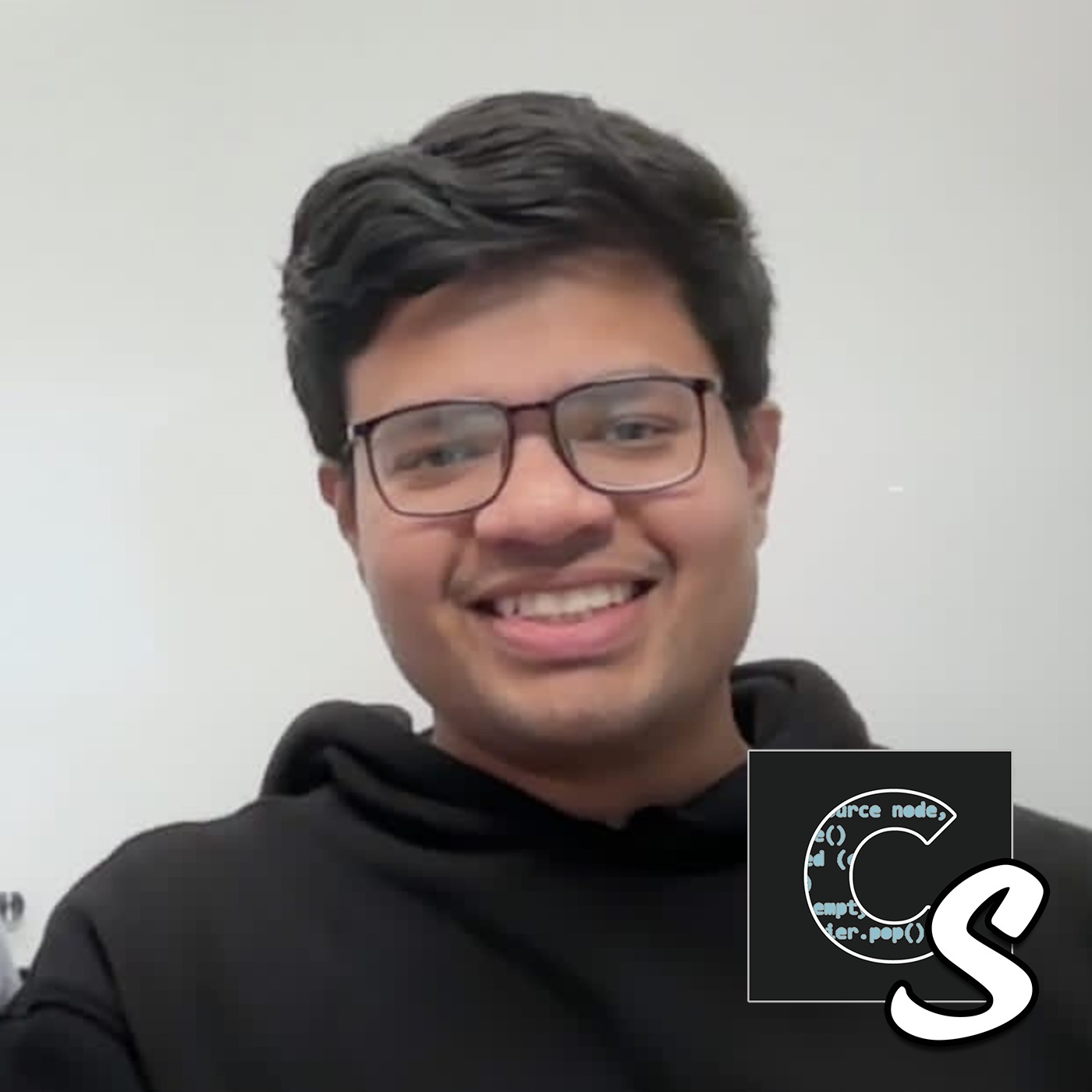
S13 Bonus: The 99% Reliability Shift: Foundation Models for Robotic Manipulation with Yash Sinha, Founder of Intelligence Factory
In this episode
Yash Sinha hates losing even more than he wants to win, as the saying goes. He was born and raised in India, growing up in Delhi and competing in sports like Cricket. He's always been intellectually curious, always looking to the next step - which both of these things led him into entrepreneurship, of which he has started several businesses. Outside of tech, he likes to read fantasy and science fiction, as he enjoys the world building of this genre.
Yash and his co-founders realized that in order for robotics to work, foundational models needed to exist for robotic manipulation. Since hardware was no longer a bottleneck, he and his team focused on building models and deploying bots centered around human level dexterity.
This is the creation story of Intelligence Factory.
Links
https://www.intelligence-factory.com/
https://www.linkedin.com/in/yash-sinha-556b411b3/
Current Sponsors:
Checkout our Stacklist! https://stacks.codestory.co/
Check out our Patreon!
Hosted by Noah Labhart | Technical Founder & Startup Mentor.
Our Sponsors:
* Check out Granola and use my code granola.ai/CODESTORY for a great deal: https://granola.ai
* Check out Perplexity and use my code pplx.ai/codestory for a great deal: https://www.perplexity.ai
Advertising Inquiries: https://redcircle.com/brands
Privacy & Opt-Out: https://redcircle.com/privacy
[SPEAKER_01]: So our biggest trade-off was one, even not for this prototype, but for the business in general, was what exactly should we sell, right? [SPEAKER_01]: Should we sell data, which is seems like a very good way to make a lot of money in the shorter term, or should we play the longer game, use the data to train our own models, and then deploy, which is much more riskier, but we believe we'll bring a lot more... [SPEAKER_01]: value in the longer term. [SPEAKER_01]: So that decision was very difficult.
[SPEAKER_01]: And I think in the end we ended up going towards the deployment side because we realized selling data doesn't have a different ability at the asteroid. [SPEAKER_01]: And today's world, if your startup doesn't have different ability at the asteroid, it becomes really hard to build a long-term sustainable business. [SPEAKER_01]: My name is Yarsena. [SPEAKER_01]: I'm the co-founder and CEO at the intelligence factory.
[SPEAKER_03]: This is Code Story. [SPEAKER_03]: a podcast bringing you interviews with tech visionaries. [SPEAKER_03]: Six, six months moonlighting goes. [SPEAKER_03]: It's the last and all of the backgrounds who share what it takes to change an industry. [SPEAKER_00]: I don't exactly know what to do. [SPEAKER_03]: It doesn't go as to get right. [SPEAKER_02]: who built the teams that have their bad company is its team's help each other, which is proud of our team. [SPEAKER_03]: Keeping scalability top of mind, all that infrastructure was up there.
[SPEAKER_03]: Yes, we've been fighting it as we grew up. [SPEAKER_03]: Total waste of time. [SPEAKER_03]: The stories you don't read in the headlines. [SPEAKER_02]: It's not an easy thing to achieve. [SPEAKER_03]: To get yourself a deficit of off, try to begin to ride the ups and downs of the start-up line. [SPEAKER_02]: To really want it. [SPEAKER_03]: Not just about technology. [SPEAKER_03]: All this and more on code story. [SPEAKER_03]: I'm your host, Noah Labhart, and today, oh, yeah, shit no.
[SPEAKER_03]: Is building human intelligence for robots? [SPEAKER_03]: So you can deploy bots with human level, dexterity.
[SPEAKER_03]: Yoshina hates losing even more than he wants to win as the saying goes. [SPEAKER_03]: He was born and raised in India growing up in Delhi and competing in sports like cricket. [SPEAKER_03]: He's always been intellectually curious, always looking for the next step, which both of these things led him into entrepreneurship, of which he has started several businesses. [SPEAKER_03]: That's how to tech. [SPEAKER_03]: He likes to read fantasy and science fiction as he enjoys the world building of this genre.
[SPEAKER_03]: Yashchen is co-founders realize that in order for robotics to work, foundational models needed to exist for robotic manipulation. [SPEAKER_03]: Since hardware was no longer a bottleneck, he and his team focused on building models and deploying bots centered around human, leveled, dexterity.
[SPEAKER_03]: This is the creation story of intelligence factory.
[SPEAKER_01]: What intelligence fact it does is we are building models, intelligence to deploy general purpose manipulation robots. [SPEAKER_01]: What this means is like on a very high level currently what we are seeing in robotics is that the bottleneck is not hard for anyone, like it has been traditionally. [SPEAKER_01]: the bottleneck has shifted to intelligence and with an intelligence if you separated there is data that is a big bottleneck because robotics data is not readily available and the other thing is how do we integrate robotics into real life because not that easy.
[SPEAKER_01]: robotics to become a commercial value proposition has to be working at 99% success rate. [SPEAKER_01]: So if you combine that we are missing data and robotics needs to work at like very high success rates, there's a massive gap that we are seeing and that's what we feel. [SPEAKER_01]: We have built this infrastructure that allows us to collect high quality robotics data we then use this to train our own models, leveraging research from the academy that they've been doing excellent research to push forward the frontier of robotics models and using that to build models that we can go and deploy in real life.
[SPEAKER_01]: So right now, [SPEAKER_01]: We have deployments, in warehouses, in groceries, in data centers, in electronics, and the idea is essentially how can we keep improving this intelligence in order to get to a point where we can have widespread, where we can have robots widespread across different industries. [SPEAKER_01]: And specifically, we focus on manipulation. [SPEAKER_01]: So, manipulation is anything that you do with your hand, and that's been our core focus.
[SPEAKER_03]: So let's dive into what you would consider the MVP for intelligence factories. [SPEAKER_03]: So the first version of this platform that you built, what sort of tools you're using to bring it to life and how long you take to build. [SPEAKER_01]: The first MVP is essentially a model or a robot that is doing big in place successfully. [SPEAKER_01]: And I think that itself is a huge challenge because begin place if you think about it. [SPEAKER_01]: It seems like a basic task with the amount of objects the diversity of objects that exist in the current world.
[SPEAKER_01]: If you think about an Amazon order and how different mine and yours Amazon orders are on a daily basis and if you're thinking of picking and backing these things, this is a very difficult challenge. [SPEAKER_01]: And if you're able to solve that, it's already a billion dollar industry. [SPEAKER_01]: So our first prototype is a robot that's like successfully able to pick it back most of the objects and that already will have a big market. [SPEAKER_01]: And I think to build that our process is we try to identify what is like the objects that we need to like that are the most.
[SPEAKER_01]: So first we will target a deployment. [SPEAKER_01]: We'll say okay these are the four or five companies that are interested in deploying with us. [SPEAKER_01]: One are the objects that the deal will in terms of the tasks that the two which is speaking back. [SPEAKER_01]: We'll then collect data for this through our data factories. [SPEAKER_01]: And then we will then use this data to create a model that can go that can be deployed with our industrial partners or our customers. [SPEAKER_01]: And as we deploy one after the other, the more deployments we have, the more data we get, the more data we get.
[SPEAKER_01]: The bigger our model's action space gets and so we can build this model that evolves into a model that can pick and pack anything and that's just a prototype So that's the first model. [SPEAKER_01]: That's the model that proves our hypothesis is already extremely valuable and then you can go into other tasks like blocking and plugging like cleaning and our idea is to build this prototype and then expand to other tasks so we can then expand the deployments that we want to do in multiple different types of industries [SPEAKER_03]: Okay, let's stay on that for a minute.
[SPEAKER_03]: I'm curious about the decision or trade-off you had to make in building that first model, the first MVP, the first piece of what you're trying to go do. [SPEAKER_03]: And I'm curious about a decision or trade-off you had to make and how you approached the problem. [SPEAKER_03]: It could be limitation and it could be dead exemptents or focus or anything like that. [SPEAKER_03]: Tell me about one of those decisions and trade-offs you had to make. [SPEAKER_03]: How you cope with it? [SPEAKER_01]: Yeah, I think the biggest trader of here is in robotics, as I mentioned, data is a big problem.
[SPEAKER_01]: And to be able to get to a point where you have enough data, there's a lot of companies striving to get this data and building to pay a lot of money to buy this data. [SPEAKER_01]: So our first, obviously, one of our unique value propositions is we can collect data, which is extremely high quality at scale. [SPEAKER_01]: So our biggest tradeoff was one, even not for this prototype, but for the business in general, [SPEAKER_01]: What exactly should we sell? [SPEAKER_01]: Should we sell data?
[SPEAKER_01]: Which seems like a very good way to make a lot of money in the charter term. [SPEAKER_01]: Or should we play the longer game? [SPEAKER_01]: Use the data to train our model, train our own models, and then deploy. [SPEAKER_01]: Which is much more riskier. [SPEAKER_01]: But we believe we'll bring a lot more value in the longer term. [SPEAKER_01]: So that decision was very difficult. [SPEAKER_01]: And I think in the end we ended up going towards the deployment side because we realized selling data doesn't have a defensibility attached to it.
[SPEAKER_01]: And today's world, if your startup doesn't have defensibility attached to it, it becomes really hard to build a lot on sustainability. [SPEAKER_01]: So if we keep selling data, our mode keeps eroding, and then at some point we have help other people build better models. [SPEAKER_01]: And we don't really have a business that can be sustained over the long term. [SPEAKER_01]: While if we deploy robots, we capture most of the more 10 robotics. [SPEAKER_01]: As for customers, it's very hard to switch between different robotics providers.
[SPEAKER_01]: So I think, [SPEAKER_01]: That logic and the fact that me and my co-founder were both robotic students and have worked across the stack helped us push towards the deployment part, rather than the data selling part.
[SPEAKER_03]: I'm curious about how you build your roadmap for intelligence factory. [SPEAKER_03]: How do you go about deciding that, okay, this is the next most important thing to build or to address with the company. [SPEAKER_01]: I think anyone who's done a startup will tell you startups are one and lost, depending on what you think you have to prioritize. [SPEAKER_01]: And when we think about roadmap, there's like the product roadmap and then there is the company roadmap, right? [SPEAKER_01]: Like the company roadmap could be like different steps of when are you hiring a system of people and when are you fundraising and then when are you doing this and that?
[SPEAKER_01]: And then on the product side is what does a product look in three months what does a product look in six months what does a product look in two years? [SPEAKER_01]: So on the product side for our sippers very clear, the any any deep tech company, not just robotics, cannot be built without extremely strong foundation. [SPEAKER_01]: Right now the culture in startup is a bit that you raise you go out and erase money and you raise these big rounds and you're able to consolidate like your position but we feel that in my opinion I think building this solid foundation be evident so that you know what you're doing and you have a very good plan to scale.
[SPEAKER_01]: Is that is the time when you go ahead and raise like a very big round? [SPEAKER_01]: So for us, our foundation is our data-infisher. [SPEAKER_01]: Like, ensuring that we can scale data of high quality consistently is extremely important for us because that's what differentiates us from most of the competitors in this current space. [SPEAKER_01]: So for the product roadmap, it was very clear that first we have to build these data factories, these operations that we're planning. [SPEAKER_01]: Whatever it needs, whatever resources we need to put into that, we have to.
[SPEAKER_01]: Once that is in a position that it can be scaled, then you go more downstream of that. [SPEAKER_01]: So once you have the data, what's next step that's training the model. [SPEAKER_01]: And then what's the next step is to like getting a deployment. [SPEAKER_01]: I think... [SPEAKER_01]: It is also important to prove that you have product market fit initially, so that's why we approached bunch of customers to show if we had this robot, what this would be useful for you, and we received a lot of yeses, which meant that we also got a few pilots.
[SPEAKER_01]: So now with the pilot being an end-go, we have the data infrastructure, now we can focus on how to get to the deadline, so build out the model. [SPEAKER_01]: and then tested in different ways before we deploy. [SPEAKER_01]: So I think that's how we thought of it, build the foundation, prove the demand, and then bridge whatever gap is necessary in order to get the product. [SPEAKER_01]: And on the team side, I think it's as as a CEO, my role is to identify what is the biggest blocker in the company's progress and work with like pull intensity to be able to solve that.
[SPEAKER_01]: I think [SPEAKER_01]: We have been a company for five months and I've seen that I think our biggest blocker was once we raised our pricey ground. [SPEAKER_01]: We had a lot of demand for a product and we just needed to do a lot of work and that was the biggest blocker was hiring and like equals. [SPEAKER_01]: So I think in that sense on the company road map it's always solving whichever is the most imminent threat to progress and then going from there. [SPEAKER_03]: Let's dig into the team then, I'm curious about how you built that team, right?
[SPEAKER_03]: You got the pre-seed round and then you went about building it. [SPEAKER_03]: Would you look for those people to indicate that they were the winning horses to join you? [SPEAKER_01]: The team to me is the most important part in the startup, by far. [SPEAKER_01]: I think there's no question and maybe I'm wrong, I'm going to be a figure that out, but I don't think anything is more important than the people that you asked to join you. [SPEAKER_01]: And we put a incremental amount of time in building this team.
[SPEAKER_01]: So we started off, first of all, we have been having a lot of great inbound from the YC job application board. [SPEAKER_01]: But that has been really helpful for us as one of the great value ads of YC. [SPEAKER_01]: And after that, I think most of my time after the funders concluded has been spent in interviews. [SPEAKER_01]: And like, because we have two positions. [SPEAKER_01]: We have two come branches. [SPEAKER_01]: We have one in America, one in India. [SPEAKER_01]: and we're hiring in both places.
[SPEAKER_01]: I think the most important side things for me is definitely first principle thinking. [SPEAKER_01]: I believe that whenever you're working on the frontier, there is no you can use your previous knowledge as residents to build to like build towards something but when you're working on the frontier, most of the time it's your first principle thinking and extrapolates if thinking that helps you build towards what we're trying to do. [SPEAKER_01]: No one has built robot models that are ready for deployment.
[SPEAKER_01]: We cannot just go by credentials and cannot just go by what person has done in the past, we also need to see how smart this person is, how good their extrapolative thinking is, and that's the first biggest criteria. [SPEAKER_01]: The second one is integrity. [SPEAKER_01]: I think a lot of the startups are killed by ego or people not accepting that they're wrong when they're wrong and I think this is very important for us I think we need people that that called on to their there's a saying in startups which is like stick to your opinions have strong opinions loosely held and that's what we look for is like a person believes in their hypothesis but it's ready to change the position [SPEAKER_01]: when there is enough evidence to do that.
[SPEAKER_01]: And then finally I think resilience is very important too. [SPEAKER_01]: I think startups, there's a lot of ambiguity, there's a lot of like points of failure, possible points where you will, your hypothesis is within our work. [SPEAKER_01]: And I think we need people who can just fail, get back up and dust themselves off and then just go to the next hypothesis. [SPEAKER_01]: And this combination that I'm describing is extremely rare. [SPEAKER_01]: Even in the most credential people, I've seen that they lack a certain part of this a certain facet of this personality.
[SPEAKER_01]: So I think that's why we have spent so much time in building this team and until now I think we have done this successfully and hopefully we can keep doing this.
[SPEAKER_03]: Let's flip to scalability. [SPEAKER_03]: I'm curious where this fits in. [SPEAKER_03]: How did you approach scale from the beginning? [SPEAKER_03]: You'd be the company for five months, so this would be something that's on your mind in the early days, but I'm also curious if even in this short time, if there have been interesting areas where you've had to fight scale as you've grown. [SPEAKER_01]: I think scalability here, the good thing about us is scalability is usually constrained by things that you take some time to build.
[SPEAKER_01]: In the era of LLMs and AI, software is much more easier to prototype and build than hardware. [SPEAKER_01]: And I think the good thing about robotics currently is that hardware is in commoditized. [SPEAKER_01]: We are seeing that hardware has become very good and become very cheap, so we don't actually focus on building the hardware at all. [SPEAKER_01]: And that's I think the main main decision that we took while we built this company, while we started this company that has helped us being more scalable.
[SPEAKER_01]: So right now our focus is on scaling data. [SPEAKER_01]: Scaling data happens with scaling people. [SPEAKER_01]: So the more people you have that help you collect data, the more data you will get. [SPEAKER_01]: and then that data essentially the higher volume of data you have trains better models. [SPEAKER_01]: And once you have a good model, the unique value proposition we have about a model says that they are hardware agnostic. [SPEAKER_01]: They can adapt to any robot hardware in 20 to 25 minutes of extra training.
[SPEAKER_01]: And after that, like the hardware is not being built, it's being bought. [SPEAKER_01]: So our models can essentially go on any hardware, and then we can deploy at any place or any time. [SPEAKER_01]: And that essentially preserves the scalability facet even in a deep tech company. [SPEAKER_01]: Because for example, your chat GPT can work on any laptop, that idea that these models can work on any robot hardware. [SPEAKER_01]: So we're never constrained with like hardware or we're not constrained by shipping time or we're not constrained by [SPEAKER_01]: the time to deploy in any place in the world.
[SPEAKER_03]: So, yes, as you step out on the balcony and look across all that you've built thus far with intelligence factory, what are you most proud of? [SPEAKER_01]: I will say the team, I know it's quite young and that we haven't had enough time with everyone until now, to be able to say that, okay, this is the best team I've ever built. [SPEAKER_01]: I don't think that will ever be the case, but it's just the amount of effort that we have put me and my co-founder also I would like to shout out my co-founder easily running all the technical interviews.
[SPEAKER_01]: the amount of effort that we put into hiring and then now I look back at the team that we built and how excited about their art of automation and how excited how smart they are and how everything is coming together very slowly. [SPEAKER_01]: We obviously have a long way to go very pretty company and we have aims of being one of the biggest companies in the world but already I can see that the team is starting to integrate well and I think it's something that is very satisfied by seeing.
[SPEAKER_03]: Okay, let's flip the script a little bit. [SPEAKER_03]: Tell me about a mistake you made and how you and your team responded to it.
[SPEAKER_01]: One of the mistakes that didn't happen but it was going to happen was again I think within hiring we were sometimes we have this ability just as humans to overindex on credentials and I think during some process some parts of this process we did overindex a little bit more on credentials and we made offers that would have been in the long term damaging to the company. [SPEAKER_01]: and ultimately that didn't end up working out, so we got saved by this coincidentally, but I think that could have been a very major mistake from the company side.
[SPEAKER_01]: But I think if you want me to talk about failures, I think the better sort of case here is my previous company. [SPEAKER_01]: So Kyle Labs is setting up a bit of context. [SPEAKER_01]: We were working on AI and robotics for material discovery. [SPEAKER_01]: This is quite a hard space to build in. [SPEAKER_01]: There's multiple reasons for that. [SPEAKER_01]: But I think we worked on it for 18 months and I think we got good results, but eventually I think the market for this technology didn't really exist and I think it took us way too long to figure that out.
[SPEAKER_01]: And I think there's a few reasons for that. [SPEAKER_01]: I think the two biggest things that are important for a startup product market fit and found an idea of it. [SPEAKER_01]: These are the two things that someone has to quantify extremely early in order to say that they start up good and have potential of being successful. [SPEAKER_01]: So let's go to the first part product market fit. [SPEAKER_01]: I think what we made the mistake in Kyle was that we fit a solution to a [SPEAKER_01]: So you could people could ask, how do you actually do that?
[SPEAKER_01]: How do you feel? [SPEAKER_01]: The solution to the problem. [SPEAKER_01]: Essentially, when you're engineer, especially working on deep tech, you always have graduate with this cool idea that you want to use and you just try to find a problem to it. [SPEAKER_01]: For example, in our case, my co-founder, he was a chemist from Cambridge. [SPEAKER_01]: and I was a robotics, a roboticist, from ETH, so thinking of combining these technologies because like, oh, we couldn't build robots for live automation, right?
[SPEAKER_01]: That would be really cool. [SPEAKER_01]: But that was already a solution that we had in our head that we were trying to fit to a problem. [SPEAKER_01]: So we were looking at, oh, should we do this for like material discovery? [SPEAKER_01]: Should we do this for drug discovery? [SPEAKER_01]: And that already is a big problem. [SPEAKER_01]: I think the first thing you have to do is actually figure out what the problem is before you build a solution and I think that was the first problem and then the other one was found right here if it were eventually in a space like robotics and AI for material discovery, it becomes you have to sell something and whatever you sell your die company so when you do AI for material discovery and find a IP or something of a material.
[SPEAKER_01]: And if you don't have buyers for it, you have to scale up. [SPEAKER_01]: You have to build that material into a reactor or something. [SPEAKER_01]: And I think that's where the gap existed. [SPEAKER_01]: Where we, this company became a process engineering company very, very fast. [SPEAKER_01]: And neither me or my co-founder had the background to back it up. [SPEAKER_01]: Identify people who would join us who would strengthen the team. [SPEAKER_01]: And I think that's what eventually led to the downfall.
[SPEAKER_01]: And I think that sort of covers the second part, but just found a idea of it.
[SPEAKER_03]: Let's move forward then. [SPEAKER_03]: This will be exciting. [SPEAKER_03]: Your five months old, beginning to the where you want to prove what you've built, I'm curious what the future looks like for intelligence factory for. [SPEAKER_03]: Where the industry is going, like you mentioned, the hardware is no longer the bottleneck, data, and all the things, what does the future look like? [SPEAKER_01]: robotics is improving at a base where different parts of the technical stack we are seeing improvements in them, a significant improvements in them and we are a product based company so our company benefits of from any improvement in the stack which gets us closer to deployment because eventually we essentially were able to leverage them and build it into our stacks so we can get closer to deployment reliably.
[SPEAKER_01]: But I think what's happening right now is that are we are looking at all these advancements and we are trying to leverage that into our stacks so that we can then go and deploy. [SPEAKER_01]: And I think in the shorter term, we are focused on building these models that are really good at one task as I explained before. [SPEAKER_01]: So you to pick and pack, then you to plug in and plug into cleaning, then you to different sorts of two use or folding clothes and [SPEAKER_01]: We deploy these one in one task use cases, so we deploy in a warehouse and a grocery in all places where one of these automating just one of these tasks is extremely useful.
[SPEAKER_01]: And as we do that, I think what happens then is we collect a lot of high quality data, both from our deployments and the data that we have used to train these models. [SPEAKER_01]: And those data combines into the model and increases its action space. [SPEAKER_01]: At some point, we get to a point where our models' action space is big enough that it's generalizable. [SPEAKER_01]: So it can do a big impact task, it can also do a plug-in and plug task, it can do a wiping task. [SPEAKER_01]: So that's a long term goal of the company, where with all the deployments we have essentially converge into a general performance manipulation model, but the medium-term outlook is to deploy multiple robots in industries with one task use cases.
[SPEAKER_03]: Yes, let's switch to you who influences the way that you work. [SPEAKER_03]: Name a person or many persons or something you look up to and why. [SPEAKER_01]: You will find this answer a bit disappointing or not disappointing, but I will say it will be a little bit different To what most of the people will say I mostly look up to sports people so I think My sort of person I look up to for a long time has been Christian Ronaldo which to be fair is like quite common between people of our age Yeah, I think it's just dedication and discipline right if you're not like the most killed person If you're not the most talented person and you don't have the best opportunities [SPEAKER_01]: How do you become the best?
[SPEAKER_01]: It's just pause zone to the dedication discipline and resilience. [SPEAKER_01]: So anyone who's anyone who embodies that sort of becomes a person I admire. [SPEAKER_01]: And I decided supporting many nights very early. [SPEAKER_01]: So I was like, yeah, I became aware of Christianity and all the first. [SPEAKER_01]: But any person inviting these skills and that their our famous or some such are our people that I admire. [SPEAKER_03]: Okay, last question, so you're getting on a plane.
[SPEAKER_03]: Interesting next to a young entrepreneur who's built the next big thing. [SPEAKER_03]: They're jazzed about it. [SPEAKER_03]: They can't wait to show it off to the world and can we show it off to you right down the plane? [SPEAKER_03]: What advice to give that person having on down this road a bit? [SPEAKER_01]: I think first of all, if he's excited to pitch to me on a plane, I think one of the things is ticked off is his initiative. [SPEAKER_01]: I think as founders, we have to be prepared to take any opportunity that presents itself and sometimes it's in a weird position, like an airplane or in a toilet or whatever, but like, you have to scrap that so I will admire that.
[SPEAKER_01]: And I think I will then analyze his speech. [SPEAKER_01]: I think a lot of the times, when I hear a wonderful speech and this is not coming from some
[SPEAKER_01]: I will say that the problem statement is almost always missing. [SPEAKER_01]: People are very keen to talk about the cool things that they're doing, which is essentially the solution. [SPEAKER_01]: But I think it's very important to spend a little bit of time on the problem itself. [SPEAKER_01]: Why you actually build like this and what are the signals that got you to that? [SPEAKER_01]: I think the more you can talk about the problem and the more normal and intuitive it becomes to the listener that this problem deserves to be solved, the solution is that much easier to understand.
[SPEAKER_01]: I think that's what I would look for in the pitch and then I think clarity of thought is also really important. [SPEAKER_01]: You think about deep technology specifically, there's people doing so many complicated things like building a efficient reactor. [SPEAKER_01]: building a fusion reactor, building robotics, building something for space, the simplicity in which you can explain your company is directly proportional to how value understand this space. [SPEAKER_01]: And I think this is also something that I look for in the people we are interviewing highly.
[SPEAKER_01]: And I think it's directly proportional to how sophisticated the
[SPEAKER_01]: And I feel that's a very good indicator of where this person stands. [SPEAKER_03]: I think all that's fantastic advice and things to think through. [SPEAKER_03]: We are, thank you for being on the show today. [SPEAKER_03]: Thank you for telling the creation story of intelligence factory. [SPEAKER_03]: Thank you.
[SPEAKER_03]: In this concludes another chapter of Coat Story.
[SPEAKER_03]: Code Story is hosted and produced by Noah Labhart. [SPEAKER_03]: Be sure to subscribe on Apple Podcasts, Spotify or the podcasting app at your choice. [SPEAKER_03]: And when you get a chance, leave us a review. [SPEAKER_03]: Both things help us out tremendously.
[SPEAKER_03]: And thanks again for listening.
Latest Season of the Podcast is Sponsored By






 Apple Podcasts
 Spotify
 Castbox
 Player FM
 Pocket Casts
 YouTube
 Overcast
 Castro
 Goodpods
 Moon FM
 Podbean
 Podcast Addict
 Podcast Republic