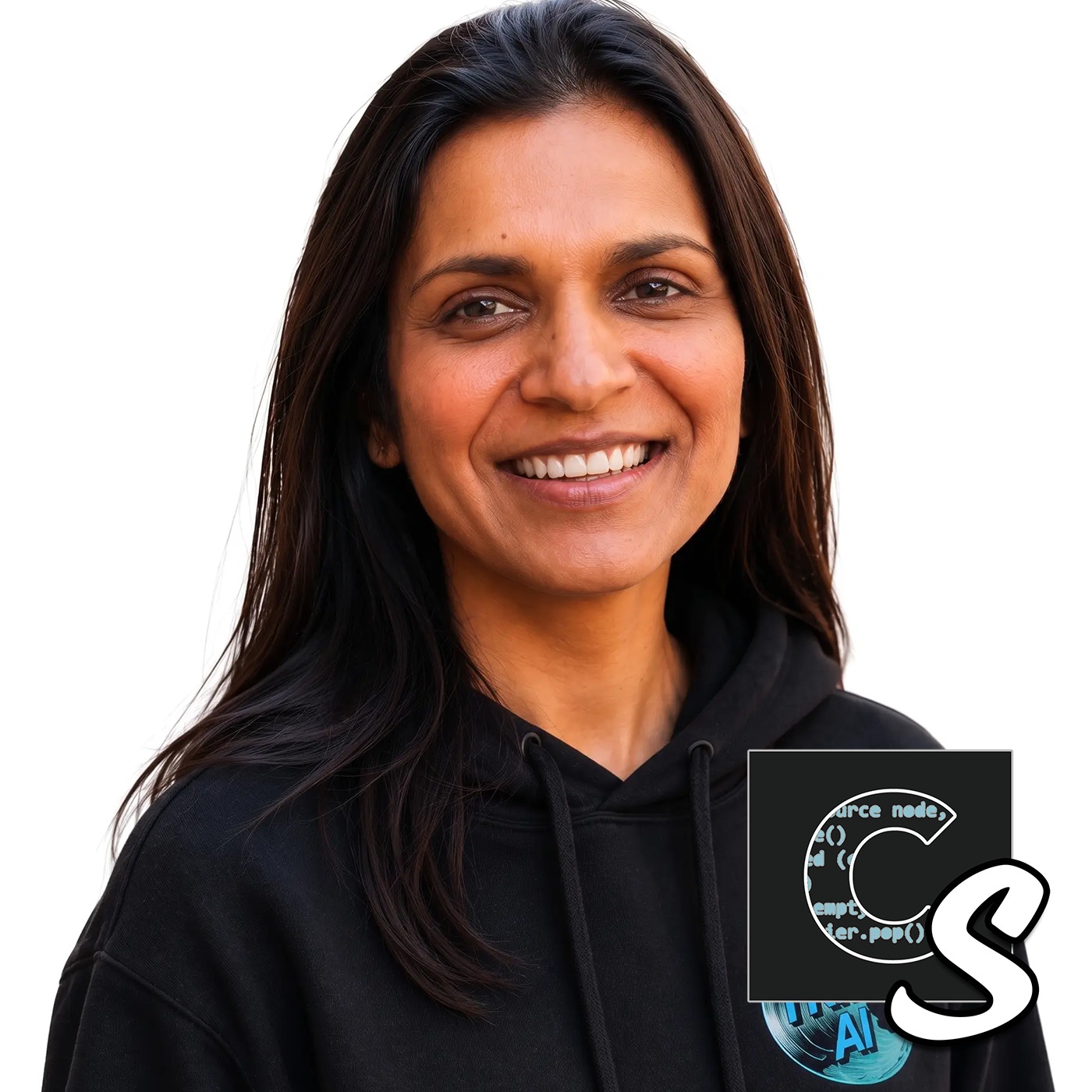
S13 E9: Forward-Deployed AI: Moving Enterprise Pilots into Real Production with Pooja Brown, CTO at Tribe AI
In this episode
Pooja Brown grew up in India, and now lives in San Francisco. Her family ran manufacturing factories that made fertilizer and medicine - IE real products, real customers, and real consequences when a batch didn't ship. She grew up learning that a product was not done until it was in the customers hands. She came stateside for university, and never left San Francisco. She's held leadership positions in many companies, some notable names being Stitch Fix and Docusign. Outside of tech, she is married with 2 daughters. She notes that in all her years in tech, home is the one place she can't automate.
In 2019, Tribe made a bet that every company would become an AI company. In the summer of 2026, Pooja joined the company during the point of hyper growth, when AI is booming but businesses are still trying to catch up and implement. She stepped in to help lead the charge and build transformational AI systems for the enterprise.
This is Pooja's creation story at Tribe AI.
Links
https://www.linkedin.com/in/pgarg/
Current Sponsors:
Checkout our Stacklist! https://stacks.codestory.co/
Check out our Patreon!
Hosted by Noah Labhart | Technical Founder & Startup Mentor.
Our Sponsors:
* Check out Granola and use my code granola.ai/CODESTORY for a great deal: https://granola.ai
* Check out Perplexity and use my code pplx.ai/codestory for a great deal: https://www.perplexity.ai
Advertising Inquiries: https://redcircle.com/brands
Privacy & Opt-Out: https://redcircle.com/privacy
[SPEAKER_01]: As CTO, you don't get to pick one MVP. [SPEAKER_01]: right is like the goal here is to actually make all projects successful. [SPEAKER_01]: We have to get an MVP in every enterprise we walk into. [SPEAKER_01]: Right is like, how do we pick up the first right use case in production that's actually doing real work? [SPEAKER_01]: And when I think about MVP's, those are not demos, not pilots. [SPEAKER_01]: These are real products doing jobs that usually people do by hand. [SPEAKER_01]: How do we bring that to life with real systems, real users that are getting value?
[SPEAKER_01]: And to me, that has been the efforts, and so I'm joined, is that how do we get these MVPs as quickly as we can? [SPEAKER_01]: And Pooja Brown, I'm CTO of Tribe.ai.
[SPEAKER_03]: This is code story. [SPEAKER_03]: A podcast bringing you interviews with tech visionaries. [SPEAKER_03]: Six, six months moonlighting. [SPEAKER_00]: It's the last and all of the backgrounds. [SPEAKER_03]: Who share what it takes to change an industry? [SPEAKER_00]: I don't exactly know what to do.
[SPEAKER_02]: who built the teams that have their bad company is its team's help each other, which is proud of our team. [SPEAKER_03]: Keeping scalability top of mind, all that infrastructure was up there. [SPEAKER_03]: Yes, we've been fighting it as we grew up. [SPEAKER_03]: Total waste of time. [SPEAKER_03]: The stories you don't read in the headlines. [SPEAKER_02]: It's not an easy thing to achieve. [SPEAKER_03]: To get yourself a deficit of off, try to begin to ride the ups and downs of the start-up line.
[SPEAKER_02]: Need to really want it. [SPEAKER_03]: Not just about technology. [SPEAKER_03]: All this and more on code story. [SPEAKER_03]: I'm your host, Noah Labhart. [SPEAKER_03]: And today, help Putra Brown is building AI that ships scales and compounds, giving enterprises not only the tools, but the results as well.
[SPEAKER_03]: Put your brown grew up in India, now lives in San Francisco. [SPEAKER_03]: Her family ran manufacturing factories that made fertilizer in medicine. [SPEAKER_03]: IE real products, real customers, and real consequences when a batch didn't ship. [SPEAKER_03]: She grew up learning that a product was not done until it was in the customer's hands. [SPEAKER_03]: She came to state side for university and never left San Francisco. [SPEAKER_03]: She's held leadership positions in many companies, some notable names being Stitch Fix and Dockysign.
[SPEAKER_03]: But outside of tech, she's married with two daughters. [SPEAKER_03]: She notes that in all her years in tech, home is the one place she couldn't automate.
[SPEAKER_03]: In 2019, tribe made a bet that every company would become an AI company. [SPEAKER_03]: In the summer of 2026, put to join the company during the point of hypergrowth. [SPEAKER_03]: When AI is booming, but businesses are still trying to catch up and implement. [SPEAKER_03]: She stepped in to help lead the charge and build transformational AI systems for the enterprise.
[SPEAKER_03]: This is Pooja's Creation Story at tribe.ai.
[SPEAKER_01]: We build AI products for the biggest companies in the world. [SPEAKER_01]: What's exciting about tribe is there's all this development that's happening outside. [SPEAKER_01]: The frontiers are busy with making models do more and more. [SPEAKER_01]: But how do these big large enterprises, the Fortune 1,000s get value off of that? [SPEAKER_01]: That's what tribe does. [SPEAKER_01]: We live inside the company's own systems. [SPEAKER_01]: We do real work, right? [SPEAKER_01]: What we're building our AI products
[SPEAKER_01]: they actually start giving you value from what the development is happening around AI. [SPEAKER_01]: And then as you use these products get better, [SPEAKER_01]: the longer they run. [SPEAKER_01]: We work with the largest customers, the high ed CFIS, as coax, Kirkland, and Ellis, doesn't matter when industry, the problem is the same in every one of them. [SPEAKER_01]: Your most valuable work is done by people. [SPEAKER_01]: It's stitched together by people, processes, systems, judgment that has locked in people's head.
[SPEAKER_01]: We turn all of that into a product that the company runs on. [SPEAKER_01]: That to us is what tribe believes in, that's where we've seen the most success, that's what we do. [SPEAKER_01]: In 2019, tribe made a bet that every company would become an AI company, and that time it might have been a contrarian view. [SPEAKER_01]: Now, everyone's doing that, right? [SPEAKER_01]: But what's the problem is that they're stuck between demos and what actually means to have a real product run.
[SPEAKER_01]: That's the gap we're filling. [SPEAKER_00]: We don't advise we build through it. [SPEAKER_01]: I spend 20 years building systems that companies run on. [SPEAKER_01]: I ran engineering a docu-sign through the IPO, ran engineering at Stitch Fix, and digitized their supply chain under its machine learning, held CPTO seeds at AI Native Education, [SPEAKER_01]: both founded, agentic supply chain company inventory and every one of those the model was the easy part. [SPEAKER_01]: Getting it to do a real work inside a real business was actually the hard part.
[SPEAKER_01]: That's what attracted me to try. [SPEAKER_01]: That's what tribe does and that's why I'm here. [SPEAKER_01]: I joined a CTO this summer and the first one this company ever had but my job here is to take what we've done there and actually build compounded scale it. [SPEAKER_01]: Right? [SPEAKER_01]: It's when I think about these companies that we work with, the first product in a company is where we get the system right, the harness right, the integrations right, the e-values, the security, the plane that these agents have to actually work on and make decisions.
[SPEAKER_01]: That's where we come in first. [SPEAKER_01]: After that, it's compounding value.
[SPEAKER_03]: I'm curious on this show, I ask a lot about MVPs, but in this scenario, I want to ask about your MVPs, so some of you joins TryBut AI, what's the first thing you stepped in to take on, with TryB, and it could have been a project, it could have been technology that used to go, build these systems with these enterprises, could be anything there, tell me about that first project that you had to go jump in, the first initiative, how
[SPEAKER_01]: as CTO, you don't get to pick one MVP, right? [SPEAKER_01]: It is like the goal here is to actually make all projects successful, and I really like the framing of MVP because we have to get an MVP in every enterprise we walk into, and it's always the same shape. [SPEAKER_01]: Right, it's like, how do we pick up the first right use case in production that's actually doing real work? [SPEAKER_01]: And when I think about MVPs, those are not demos, not pilots, these are real products doing jobs that usually people do by hand, but how do we bring that to life with real systems, real users that are getting value?
[SPEAKER_01]: And to me that has been the efforts, since I've joined, is that how do we get these MVPs running as quickly as we can once we enter an account once we enter an enterprise? [SPEAKER_01]: And what it takes to get there, that's also a systematic process. [SPEAKER_01]: We need a business owner, we need to have a clear metric. [SPEAKER_01]: The definition of steel thread hasn't changed. [SPEAKER_01]: What is the path to get from an engineer's laptop all the way to production? [SPEAKER_01]: Within an enterprises security plane within their governance within their guardrails.
[SPEAKER_01]: How do we do that? [SPEAKER_01]: Pocies in my mind are great in terms of getting people aligned in terms of getting people on the same page. [SPEAKER_01]: But those are pre-sales artifact. [SPEAKER_01]: RNVPSTRI is how do we get Earth's use case in an enterprise up and running that includes everything from moving code from a developer's machine all the way to production. [SPEAKER_01]: Through the EVAL loops, through the audit trails, through the EVALs, through the security guardrails, so an actual user.
[SPEAKER_01]: can see value from it. [SPEAKER_01]: This is the major substrate that we need to put in place and that's what we think is the MVP. [SPEAKER_01]: Once you have that, the number of use cases that can then start compounding value and leveraging that, those become infinite. [SPEAKER_01]: But then this is the place where we, as a team, have been pushing a lot on how do we get MVP's and enterprise going? [SPEAKER_01]: as soon as possible because that's where the hard work is. [SPEAKER_01]: After that, every other use case just takes advantage of the work that we put in.
[SPEAKER_03]: I'm curious with tribe, and with your time at tribe, it's been maybe a couple months or a few months there. [SPEAKER_03]: Tell me about maybe a decision or trade off you had to make in taking this new role on where you're taking all the MVP's, you know, wanting to make them successful, and you're wanting to deploy these things faster. [SPEAKER_03]: Tell me about a decision or trade off you had to make a pillar kind of one, and how you cope with it. [SPEAKER_01]: You're making trade-offs all the time, right?
[SPEAKER_01]: So there's no point in time where you made a trade-off. [SPEAKER_01]: You're making these every day. [SPEAKER_01]: The first one I would call out is like, how much autonomy you want to give the product and day one. [SPEAKER_01]: Everybody wants full it. [SPEAKER_01]: Full the autonomous versions running immediately. [SPEAKER_01]: But you need to actually earn the right to do that. [SPEAKER_01]: One run at a time, right? [SPEAKER_01]: This is where some of the trade-offs come in is that absolutely we can aim to build a fully autonomous [SPEAKER_01]: How do you bring people along in that journey?
[SPEAKER_01]: How do you make sure that these agents actually understand the work your people do? [SPEAKER_01]: Create output, create value, get corrections from your team, and then continue to compound on that. [SPEAKER_01]: That to me are decisions that we're constantly making is what is the level of autonomy that we actually want to give agents. [SPEAKER_01]: I learned this honestly the hard way when I was replad forming things at DocuSign. [SPEAKER_01]: One of the big things that the system that I was responsible for transforming It was really critical for us to understand what the old system did, how it worked, and then bring people along to the new system even if it was a lot better.
[SPEAKER_01]: We'd also realize that there were so many workarounds and bugs that were built in the old system that need to actually port it over as new capabilities or new features, new ways of working. [SPEAKER_01]: So I think the big trade-outs for us is that how much level of autonomy that we want to bring in to our systems and what is the threshold in terms of when agents are actually
[SPEAKER_01]: For us, solving a client's problem is really important. [SPEAKER_01]: Right, solving it from scratch at this time is much faster. [SPEAKER_01]: Building the reusable pieces that are slower, but then actually compound, as we said, more use cases for the customer and create more value, that takes tension, that takes conversation. [SPEAKER_01]: The coping mechanism is you got to name these tradeoffs out loud. [SPEAKER_01]: You got to bring the teams along. [SPEAKER_01]: Your teams, your customers, teams.
[SPEAKER_01]: So they know why some things are slowing down to create value for you later.
[SPEAKER_03]: I'm curious about how you are progressing and maturing, how you go about implementing and building these systems for enterprises. [SPEAKER_03]: There's processes, there's how you deploy this to wrap in a box what I'm curious about is how do you build your roadmap for Tribe.AI? [SPEAKER_03]: For the company, for how you offer your services and how do you decide that, okay, this is the next most important thing to build or to address. [SPEAKER_01]: Two years ago, the models could help a person do the work.
[SPEAKER_01]: Today, the models can do the work themselves, so our product has to change with them. [SPEAKER_01]: When you think about the models and you think about the product that leverages the models, originally it started with a smart layer on top of a model. [SPEAKER_01]: Parsons still does the job, the model drafted or suggested. [SPEAKER_01]: Now, you're in a world where the agent actually does the job and the person checks it. [SPEAKER_01]: Every time a person corrects the agent, [SPEAKER_01]: and the agent gets a little more room to work on its own.
[SPEAKER_01]: We measure it against what actually happens in the business. [SPEAKER_01]: Did that think that the outcome that we promised actually get achieved? [SPEAKER_01]: When you think about this journey from a, I'd say you're automating or digitizing the keyboard versus digitizing the human. [SPEAKER_01]: That's a journey. [SPEAKER_01]: That's a journey that we've made as model development as increased as the scope has changed as these capabilities have come to life. [SPEAKER_01]: The roadmap builds itself.
[SPEAKER_01]: The first product in a company is always a really expensive one because you're setting up the integrations, the e-values, security, all the things that you need to set up for these agents and models to work effectively. [SPEAKER_01]: The second one, we use as it all of it, then you start really looking at what is the actual roadmap of the enterprise that you're working with. [SPEAKER_01]: What are the outcomes that want to achieve and what the system that we've built for them can unlock.
[SPEAKER_01]: So to us, that is the roadmap. [SPEAKER_01]: Our roadmap really is determined by two aspects. [SPEAKER_01]: What is the development that's happening in the models with the frontiers? [SPEAKER_01]: What is the actual outcomes that the businesses are trying to achieve? [SPEAKER_01]: and how we set up systems and platforms that enable that over time. [SPEAKER_01]: The big thing for us is how do you create these learning loops in AI products where these loops outlive our engagement, right?
[SPEAKER_01]: We know what an AI product is, an AI product is a product that gets better as it's being used. [SPEAKER_01]: How do we set up those systems where these products evolve through these learning loops? [SPEAKER_01]: as context changes, as new information comes in, as business processes evolve. [SPEAKER_03]: I'm curious about team, who judge how build your teams, and what do you look for in those people indicate that they are the winning horses to join you? [SPEAKER_01]: I love this question, we are growing so fast, we are hiring hundreds of people over this year, and the bar doesn't change for us.
[SPEAKER_01]: Everybody that we hire here still builds, every person, every level, [SPEAKER_01]: They all do the same take-home exercise I did when I took the CTO job and I loved it. [SPEAKER_01]: I just said it is so important for us to have the same bar across every person who joins tribe. [SPEAKER_01]: If we're asking people to ship inside Fortune 1,000, everybody here has to be able to ship and the take-home for us tells us two things. [SPEAKER_01]: Can you work well with agents because that is basically your job now?
[SPEAKER_01]: Do you have the judgment [SPEAKER_01]: to stare at these agents because the models will do the easy parts, and what matters is what you do next. [SPEAKER_01]: The work to me is a mix, we're looking for people who can stare at agents, work with people, learn how a business actually runs. [SPEAKER_01]: The best people here like sitting with actual teens who are doing real, work flows. [SPEAKER_01]: whether it's inside banks, whether it's like law firms figuring out how really work gets done and earning enough trust with our customers so we can actually influence and change how work is done.
[SPEAKER_01]: That's a very different scale from writing code and you need both. [SPEAKER_01]: The people we want to work with are the best at what they do. [SPEAKER_01]: They're very smart and extremely humble. [SPEAKER_01]: It's about the value the outcome that they created for the customer. [SPEAKER_01]: would they built it with? [SPEAKER_01]: It's not about just them. [SPEAKER_01]: For me, that's a really important trade as we think about hiring smart, humble, and culturally aligned people with tribe.
[SPEAKER_03]: I want to flip over to scale and this will be interesting given how you solve problems for enterprises and the tools that you're building to help you do so and the teams that you're building, I'm curious about how you approach scale and then also I'm really interested in if there's has been interesting areas where you've had to fight scale as you grow and that could be technology people, all the things. [SPEAKER_01]: Two things in my mind pull against each other. [SPEAKER_01]: Burst is you don't want to over-optimize, right?
[SPEAKER_01]: As a founder, you always want to put the outcome first and get to their as fast as possible. [SPEAKER_01]: but you can't always do that because as you scale, you want repeatability and repeatability takes time. [SPEAKER_01]: Every time we duplicate work, we did not scale. [SPEAKER_01]: And we all know at this point, it's not infrastructure scale that your limits is actually knowledge scale. [SPEAKER_01]: When you're sitting in an enterprise, the product has to get smarter on its own.
[SPEAKER_01]: Agent Strun, people correct them, [SPEAKER_01]: every question feeds back into the system automatically. [SPEAKER_01]: That's the learning loop. [SPEAKER_01]: How do you build that loop in a way that it is actually a repeatable rule? [SPEAKER_01]: No matter what the business context looks like, that's hard. [SPEAKER_01]: When you think about scaling those if that's how we think about approaching the problem of scale, across tribe we have hundreds of engineers that are working with multiple enterprises.
[SPEAKER_01]: And the job there is how do you get smarter from each other's work instead of relearning the seamless. [SPEAKER_01]: That's where the hard part is there. [SPEAKER_01]: The industry is calling itself our factory. [SPEAKER_01]: We call it tribe knowledge. [SPEAKER_01]: How do we make sure that every engagement that we walk into, we are not starting from zero? [SPEAKER_01]: We want to start from 40, 50, 60, want to start so ahead that then the last 40% is actually just focused on creating, understanding your workloads, your business, things that make your product a lot more adoptable, versus starting, [SPEAKER_01]: all the way from scratch and building an agentic platform and a learning loop on top of it.
[SPEAKER_01]: Those problems are exactly the same across all enterprises. [SPEAKER_01]: It is then it is the last piece which is where we want our engineers to be focused on, and that's the balance between how do you create repeatability and scale into driving outcomes for the enterprise, but also having a real understanding of what their true work flows are and how we will
[SPEAKER_03]: So, I know with Tribe.ai, you've been there for a few months, but I'm still curious of your time there as you step out on the balcony, look across what you've built this far. [SPEAKER_03]: What do you most proud of? [SPEAKER_01]: I never stand in the balcony who's got the time anymore, but if you're going to make me do it, I think about the pattern across my entire career. [SPEAKER_01]: I'm proudest of the systems that are still running after I left. [SPEAKER_01]: DocuSign, I joined at 80 people rebuilt the platform through the IPO.
[SPEAKER_01]: Our competition back then was paper. [SPEAKER_01]: That system today now still carries the largest share of the world agreements. [SPEAKER_01]: That's just fixed everyone talked about the algorithm. [SPEAKER_01]: I focused on digitizing the supply chain underneath it, so the algorithm was picking real inventory instead of guesswork. [SPEAKER_01]: Buyer stopped doing business over email and goal calls. [SPEAKER_01]: Really major changes that impact how people work. [SPEAKER_01]: So when I look at tribe, I know what it takes for something to survive inside a company, and I've seen it work across finance, retail, education, supply chain, multiple industries.
[SPEAKER_01]: That's the bar I want to hold for every product we should. [SPEAKER_01]: That's the way I think about the impact that I'd want to create at tribe. [SPEAKER_01]: We want to outlive the engagements through the amazing products that we're building for our customers, so they continue to get more value from it. [SPEAKER_01]: That's the way I think about when I do actually get time to stand on a balcony.
[SPEAKER_03]: Let's flip the script a little bit. [SPEAKER_03]: Tell me about a mistake you made and how you and your team responded to it. [SPEAKER_01]: It's really easy to walk in and assume that you are aided with the right tools, you know, the right technology stack, you know, all the development that has happened that is going to change how you work. [SPEAKER_01]: At DocuSign frankly, I was hired to replace the platform and I walked in thinking I really had it. [SPEAKER_01]: Now at a new team, you sit, you knew technology stack at that time.
[SPEAKER_01]: When I missed to us, [SPEAKER_01]: really understanding how people had worked with the old systems, and what are the norms and processes that they established around that? [SPEAKER_01]: So when even the new system came along, it was almost like organ rejection. [SPEAKER_01]: It was so much better than the last one, but I couldn't figure out why customers weren't using it. [SPEAKER_01]: And what I realized was, I hadn't made the effort of actually bringing them along. [SPEAKER_01]: Doesn't matter how good your system is, doesn't matter how amazing your technology stack is, doesn't matter how fast you got to production.
[SPEAKER_01]: Ultimately, you have to bring people along to change, even it is even if it is so much better. [SPEAKER_01]: And it's not just your customers, it's your team, it's your people you work with. [SPEAKER_01]: To me, that's the biggest learning. [SPEAKER_01]: As we as leaders, I go into be a part of transformations are entire lives. [SPEAKER_01]: Those transformations can be technology, that how you work, how you think. [SPEAKER_01]: Those things will always keep happening. [SPEAKER_01]: But how you bring people along, that right, is going to matter the most.
[SPEAKER_01]: And just knowing that, just being able to call it and being able to invest time and bringing people along, is really going to help you drive the outcomes that you're looking for.
[SPEAKER_03]: This will be super fun, I'm excited to dive into this. [SPEAKER_03]: What does the future look like for Tribe.AI? [SPEAKER_03]: Things are changing, AI is changing the game, the models change regularly, change, right? [SPEAKER_03]: What does the future look like for Tribe.AI? [SPEAKER_03]: For what you offer for your team and for where the industry is going, all the things. [SPEAKER_01]: future is all about scale, bigger transformations and faster. [SPEAKER_01]: We walk into a company today, ship a few AI products in a few weeks.
[SPEAKER_01]: I want whole functions shipped in full, right, underwriting onboarding claims processing. [SPEAKER_01]: How do we do that as fast as we can? [SPEAKER_01]: Right, and how do we do that in a repeatable way is the only way I can imagine how we scale. [SPEAKER_01]: what we build in one company, what we learn from it, how we bring it to the next engagement, how we bring the systems, the harnesses, the people, the integrations, the e-heavals, everything that I've learned I want to be able to scale that out to every next enterprise that I walk into.
[SPEAKER_01]: So the engagement 50 is from way way faster than the engagement 5. [SPEAKER_01]: that's how we think about the future, right? [SPEAKER_01]: To us, it's the same problem over and over again. [SPEAKER_01]: And how we just get there faster, and how we convert larger and larger use cases, problems with these enterprises. [SPEAKER_01]: So they're getting to the outcomes that we're promising in a much smaller, much reputable, faster manner. [SPEAKER_01]: To me, that's the job, that's the roadmap.
[SPEAKER_01]: That's where all of my energies focused on. [SPEAKER_03]: Okay, Pooja, let's switch to you. [SPEAKER_03]: Who influences the way that you work? [SPEAKER_03]: Name a person or many persons or something you look up to in why. [SPEAKER_01]: Two people that come to mind. [SPEAKER_01]: First is, and I hope everybody knows about Brewster Kale, Brewster Kale, founder of Internet Archive, a legend in itself. [SPEAKER_01]: My first job out of USF was at Internet Archive. [SPEAKER_01]: Most days, it was early in its beginning, we just started this ambitious mission to archive knowledge.
[SPEAKER_01]: And it was just me and Brewster sitting in the studio, hanging out, scanning books, and essentially taking on this job of taking everything that was captured in books, transcripts, old transcripts, and then actually digitizing it. [SPEAKER_01]: I traveled the world with him, scanning books and templates in South India that nobody actually could even reach. [SPEAKER_01]: But the really cool part of it was despite them being digitized, we spent, you know, we actually build a mobile, be used to call it bullet, it was Book Mobile.
[SPEAKER_01]: That where we built a van that could print and bind them anywhere in the world. [SPEAKER_01]: The lesson I really reached learned there was that digitizing knowledge was easy, but getting it into people's hands is the product. [SPEAKER_01]: That's the value that we were creating. [SPEAKER_01]: So I think that was like my biggest learning as I think about my journeys, my professional journey. [SPEAKER_01]: The other person that I think of as Tom Gonser was the founder of Doc Design.
[SPEAKER_01]: And to me, the lesson I learned there was that he started with the smallest possible problem.
[SPEAKER_01]: So much friction would just take paper, sign it, backs it back, do the same. [SPEAKER_01]: My first project was literally integrating with the fax machine. [SPEAKER_01]: To me, the big learning there was that when you solve that one problem and really create that sticky moment, you look at the license to rinse and repeat that over and over again. [SPEAKER_01]: your customers going to trust you, you can take bigger leaps and what is that real one small problem that you can solve that then gives you the right to solve bigger problems.
[SPEAKER_01]: To me, those are the two people who really impacted my career, I'm excited to be working with Jackie and Noah now that [SPEAKER_01]: founders of tribe, they have the same thesis, the same way to think about how do you breathe value with one use case at a time and how do you create repeatability in your systems? [SPEAKER_01]: And I now get to be the person who scales it out.
[SPEAKER_03]: Booger last question. [SPEAKER_03]: So you're getting on a plane and you're sitting next to a young entrepreneur who's built the next big thing. [SPEAKER_03]: They're jazz about it, they can't wait to show it off to the world and can't wait show it off to you right there on a plane. [SPEAKER_03]: What advice do you give that person? [SPEAKER_03]: Having led so many groups and now leading the charge at Trabeyei? [SPEAKER_01]: Honestly, this is a really hard time to start something new.
[SPEAKER_01]: The space is really messy, founder journeys are really hard, and things are changing so fast every week, every month. [SPEAKER_01]: What's true in March is not true in September anymore. [SPEAKER_01]: So don't optimize for being right, optimize for the learning. [SPEAKER_01]: great that you're on a founder journey, right? [SPEAKER_01]: But make sure that you are exposing yourself to enough problems out there, so you have strong conviction that what you're building actually solves a problem.
[SPEAKER_01]: For me, when I thought about this journey of moving from founder to tribe, the function that I was solving for myself was, where do I learn the most and the fastest? [SPEAKER_01]: Sometimes it's your own company. [SPEAKER_01]: Sometimes the answer is going where people and problems give you the most exposure. [SPEAKER_01]: And that's why I'm here at Tribe. [SPEAKER_01]: I see so many industries and every fungerer model at once. [SPEAKER_01]: I learn more in a month than I would year in one product.
[SPEAKER_01]: And if you are taking down the founder journey, make sure that you know what you're actually trying to solve
[SPEAKER_01]: Second thing I would say is really get close to the problem. [SPEAKER_01]: In your mind, this could be really the next big thing, but sit with the people who do the work before you declare that it's the next thing, before you actually even build anything. [SPEAKER_01]: And then lastly, it says, being right about the future is just not enough anymore. [SPEAKER_01]: I was building agents in 2009, 15 years early. [SPEAKER_01]: The idea was right, the tech really wasn't there. [SPEAKER_01]: Build what exists today, and really solve outcomes.
[SPEAKER_01]: Versus the next big thing. [SPEAKER_03]: I love that advice and couldn't agree more. [SPEAKER_03]: Put your thank you for being on the show today, and thank you for telling your creation story at tribe.au. [SPEAKER_01]: I'm very happy to have spent time with you, Nella. [SPEAKER_03]: And this concludes another chapter of Coat Story.
[SPEAKER_03]: code story is hosted and produced by no a lab port. [SPEAKER_03]: Be sure to subscribe on Apple podcast, Spotify, or the podcasting app at your choice. [SPEAKER_03]: And when you get a chance, leave us a review, both things help us out tremendously.
[SPEAKER_03]: And thanks again for listening.
Latest Season of the Podcast is Sponsored By








 Apple Podcasts
 Spotify
 Castbox
 Player FM
 Pocket Casts
 YouTube
 Overcast
 Castro
 Goodpods
 Moon FM
 Podbean
 Podcast Addict
 Podcast Republic